
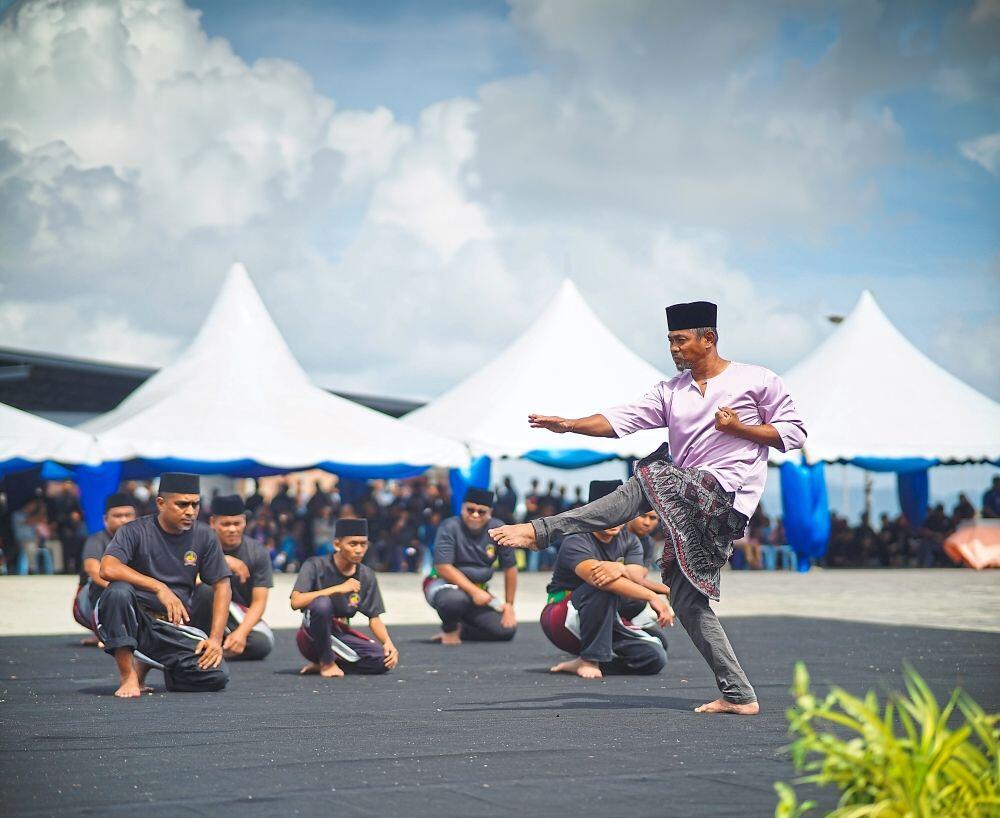

Buah Pukul Mersing is a Malay art of self-defence that has its origins in Chinese and Middle Eastern fighting styles. Known for its destructive bare-handed techniques (capable of neutralizing an opponent in a single move), it is a no-nonsense offensive style of martial fighting that uses all the limbs as weapons to avoid being hit.
Unlike other silat styles that feature a bunga (an elaborate, choreographed movement), Buah Pukul is more straightforward and to the point. When the practitioner is attacked, they deflect it first by blocking, avoiding, or catching it. Then they respond immediately with a counter-attack, using bare hands or weapons. Amazingly, the entire exchange is over in seconds. There are several other equally deadly traditional martial arts. Discover them in Traditional Malaysian Martial Arts Beyond Silat.


Historical Background
Syed Abdul Rahman Al-Yunani, a Chinese Muslim of Arab descent, brought Buah Pukul techniques with him to Malaysia in the late 19th century. According to legend, when he landed in Singapore, he was attacked by eight dock workers. But surprisingly, he defeated them single-handedly.
When news of his formidable skills reached the Johor palace, the Sultan sent the commissioner of Endau, Awang Daik, and his friend, Muar police chief Pak Long Mat Yasi, to investigate. Upon reaching there, they invited Syed Abdul Rahman to a sparring match, but Abdul Rahman routed the pair effortlessly. Awed by his skills, the duo (both silat practitioners) became his students.
However, due to British restrictions on martial arts training in Singapore at that time, Abul Rahman was invited to teach at Mersing. This relocation gave rise to the name: Buah Pukul Mersing. Eventually, after teaching them, Syed Abdul Rahman certified them as grandmasters in 1897, making them the second-generation grandmasters of this martial art.
Learn how Buah Pukul is practised in the Borneo region by reading the Indigenous Arts of Sabah and Sarawak.
Lian Padukan - A Variant of Buah Pukul
Over time, as the martial art spread, it took on various forms. They began to be known by several names, such as Gayang Lima, Lian Paduka, and Senjata Lapan. Lian Padukan is one such specific style within Buah Pukul that shares similarities with Chinese Wing Chun.
The modern Lian Padukan, as we know it today, was founded by Pak Mat Kedidi, who incorporated techniques from Silat, Muay Thai from Thailand, Tomoi, and Chinese boxing methods to produce a unique style different from all other forms of Silat.
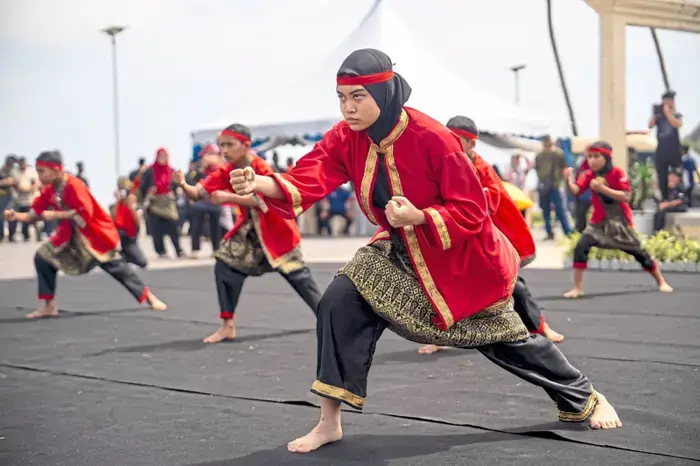
Today, LIAN has expanded throughout the Malay Peninsula in states such as Pahang, Terengganu, and Selangor, and has become an essential part of its culture. The essence of Lian can be summed up as follows:
“Cara-cara tak nak kena dan cara-cara nak mengena.” (To hit and to not be hit!)
Lian Malaysia
Buah Pukul Training Philosophy
Buah Pukul is based on gestures. It comprises two core components: physical (maknawi) and movement (murni).
Physical Component
Physical component includes techniques like hitting, punching, grappling, shielding, and wrestling. The aim is to overpower the opponent. Victory is declared when the slower opponent loses.
Movement Component
The movement component focuses on:
· Placement: Positioning of the body relative to the opponent
· First: Being the first to move or act
· Arrival: Executing movement at the exact, decisive moment
Unlike the physical component, where the goal is to hold down the opponent, in movement, the outcome is to be the first to make a move and strike.
But not everyone is qualified to teach Buah Pukul techniques. Training under a certified coach is essential to ensure you learn the proper techniques and minimise the risk of injury due to incorrect teaching steps.
Key fighting styles of Buah Pukul
Buah Pukul Mersing follows an offensive fighting style. It delivers several rounds of close-range, destructive strikes on key pressure points and vital areas of the body. These attacks are delivered in quick succession to neutralise attackers swiftly—even when there are multiple opponents.
Did you know that Tomoi is also a close-range martial art? Learn more by reading Tomoi in Kelantan: Muay Thai’s Cousin with a Twist to know more.
Its USP is fighting multiple opponents at once. Students train in a range of techniques to deal with incoming threats. Smooth fluid movement combined with street-level application tactics gives Buah Pukul the reputation of an undefeatable art.
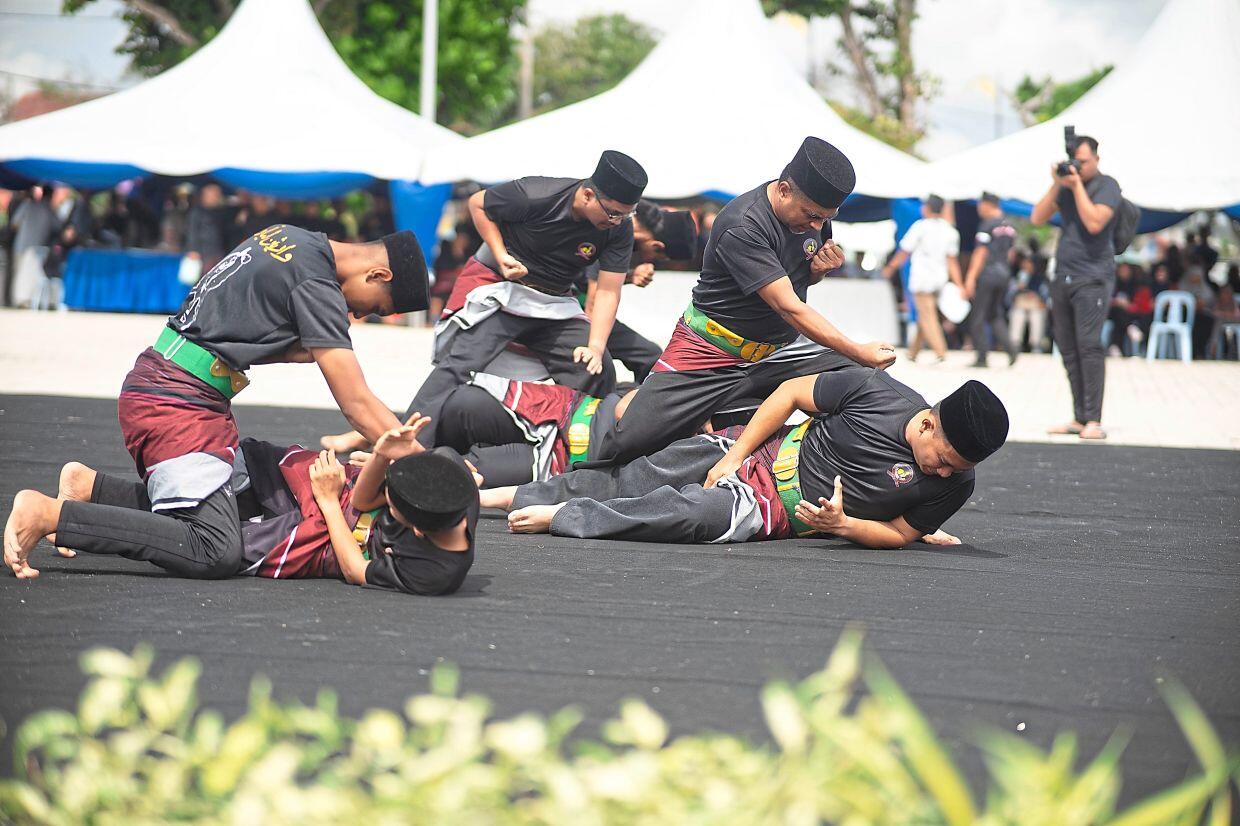
Training takes place in 5 stages, with each stage designed to grade the student's skill and fighting ability. But, unlike other martial arts, like karate or judo, there is no outward rank or belt system in Buah Pukul. Progression is private and is restricted between the student and their grandmaster.
- Grading is carried out in secret behind closed doors in front of the grandmaster and other trainers
- The grandmaster evaluates the student’s skills and decides if he is permitted to move on to the next stage
- The student is awarded a certificate at each stage. In case they fail, they have to repeat the stage
- Upon completion of the fifth stage, a successful student is given a special recognition known as nukil (spiritual authentication)
While the entire syllabus can be finished in 6 to 7 months, on average, a student takes up to two years to be fully proficient.
Those students who wish to undergo more rigorous training learn the feared Tujoh Makam (also known as the Buah Seminggu), where they train with their teacher each and every hour of seven days.
Buah Pukul vs Silat
Although Buah Pukul comes under the ambit of silat, there are several key differences between them.
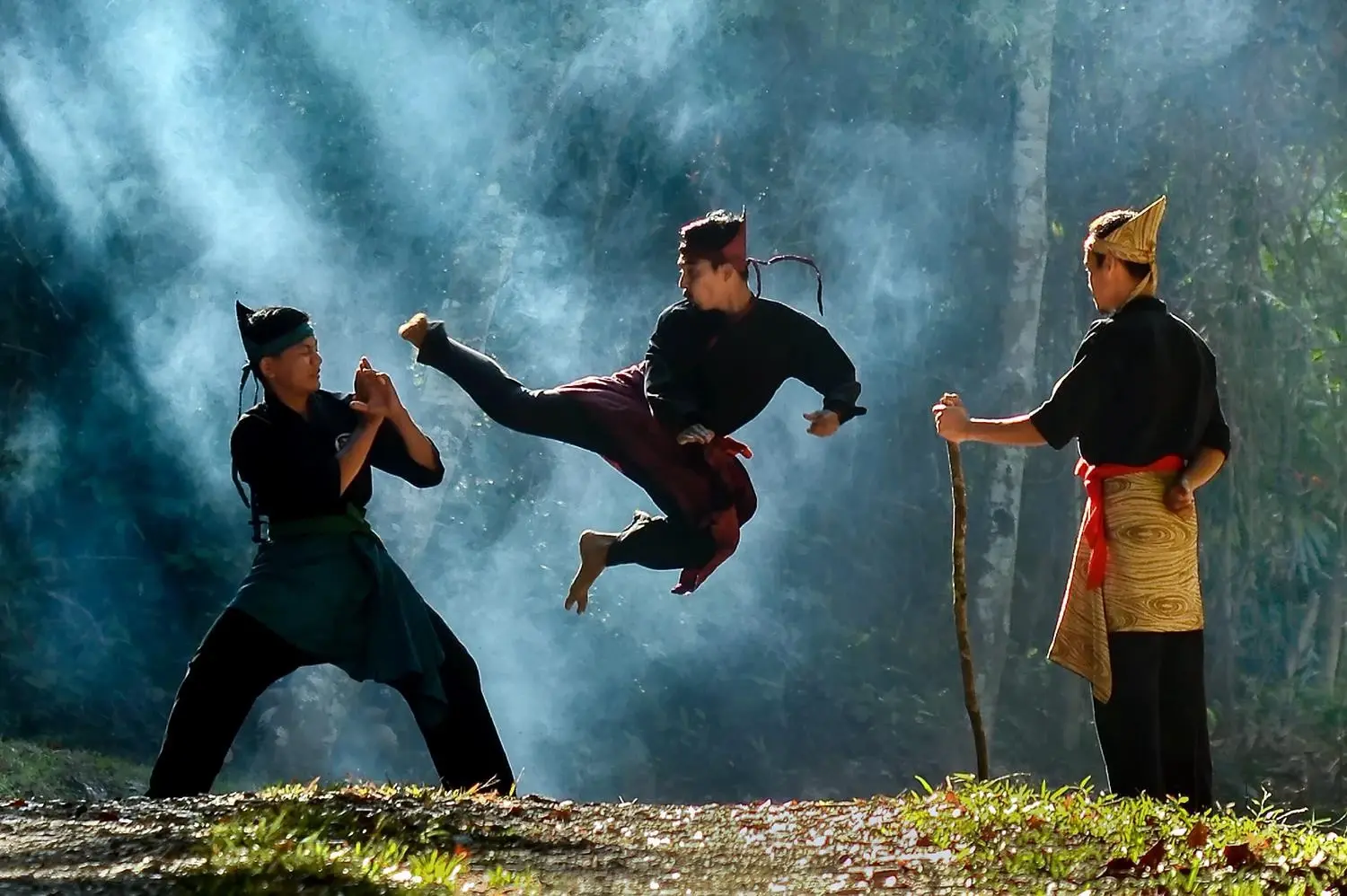
Here is how they differ
| Feature | Silat | Buah Pukul |
|---|---|---|
| Origin | Indigenous to Malay Archipelago | Originated from China |
| Fighting Style | Varied styles | Combat style |
| Bunga | Central to training | Absent |
| Weapons | Use variety of weapons | Fought mostly with bare-hands |
| Philosophy | Includes aggressive attacks along with spiritual and self-discipline elements | Direct and aggressive attack |
| Modern Status | More well-known globally. Practiced in Southeast Asia and abroad. | Popular in Malaysia and small fan following abroad |
Preserving the Legacy
Pak Mat Samurai
One of the most famous exponents of Buah Pukul was Sulieman Ariffin—better known by his nickname Pak Mat Samurai. Interestingly, he earned that nickname because of his love of the television series, The Samurai, and also because he was a skilled bladesmith who crafted his own swords, especially the Shuriken/throwing star, adding to his aura.
A 5th-generation mahaguru, he took the art handed down by his gurus through successive generations and created a new martial art. He combined Buah Pukul Mersing, Tomoi, and Silat Sendeng to create the 99 forms of Lian Padukan—a highly effective close combat art.
For Pak Mat, Buah Pukul is not a sport, but purely for self-defence.
“There’s no art in Buah Pukul Mersing. It’s not sports. It’s only for self-defense.”
·
Source: NST Online
According to him, Buah is taught in a closed arena as it is a rahsia (secret), reinforcing the Buah Pukul code that
“The student’s secret is with the teacher and the teacher’s secret is with the student.”
Revealing the code is tantamount to betraying one’s teacher.
Guru Haji Md Hasyim Salleh
Guru Hasyim is a leading student of Pak Mat Kedidi, and was, at one time, his appointed successor. Based in his hometown, Johor, Haji Hasyim has groups across Malaysia and other international locations.
He has been instrumental in expanding the range of practice weapons that extend beyond the traditional iron truncheons and short staff. He also encourages his students to participate in competitions, hoping this will lead to a revival of traditional martial arts in Malaysia.
Che'gu Nigel Sutton
Che'gu Nigel Sutton trained under Guru Mohammed Hasyim and is only of only nine individuals to complete the Khatm under his guidance. With his guru’s blessings, Nigel has been appointed Chief Instructor of Lian Padukan Europe and has been entrusted with the task of promoting this martial art in the West.
He currently lives in Malaysia, where he practices and teaches a wide range of traditional martial arts throughout the year. He is also an active member of the Malaysian Association of Grandmasters of Martial Arts, the Persatuan Silat Tua Pulau Pinang, and the Nanbei Shaolin Martial Arts Association.
Cultural Events and Preservation
In January 2025, the Mersing Buah Pukul Silat Assembly 2025 was held at Mersing Monument Square, bringing over 400 students from 38 schools from all over the country. The focus of the event was to draw attention to Buah Pukul Silat and other traditional silat arts.
The highlights of the event include:
- performances from 38 Buah Pukul Silat schools
- presentation of the SIAP Honorary Commander’s Sash Award
- presentation of the SIAP War Commander’s Sash Award
Following the success of this event, the Mersing District Office is now considering a proposal from SIAP plans to construct a silat pukul pavilion near Dataran Monument Mersing.
Buah Pukul Today
Buah Pukul Mersing has gained a significant reputation as a lethal martial art. Favoured by the royals, this once strictly guarded system has now become accessible to everyone. Today, it is being revived by martial arts exponents in Malaysia with efforts being made to popularise it outside the country, too.
Are you interested in learning Buah Pukul Mersing? If yes, you have come to the right place. At Superprof, we have it all sorted for you. We are an online platform that connects learners to tutors across the world. So even if you are based abroad - say Singapore, Thailand, or further afield, we have got you covered. Our vetted martial arts instructors are highly qualified and ready to introduce you to the thrilling world of Buah Pukul.
You are guaranteed to find a tutor who will meet your needs. Contact us today!
Summarise with AI:
Did you like this article? Leave a rating!

 Loading...