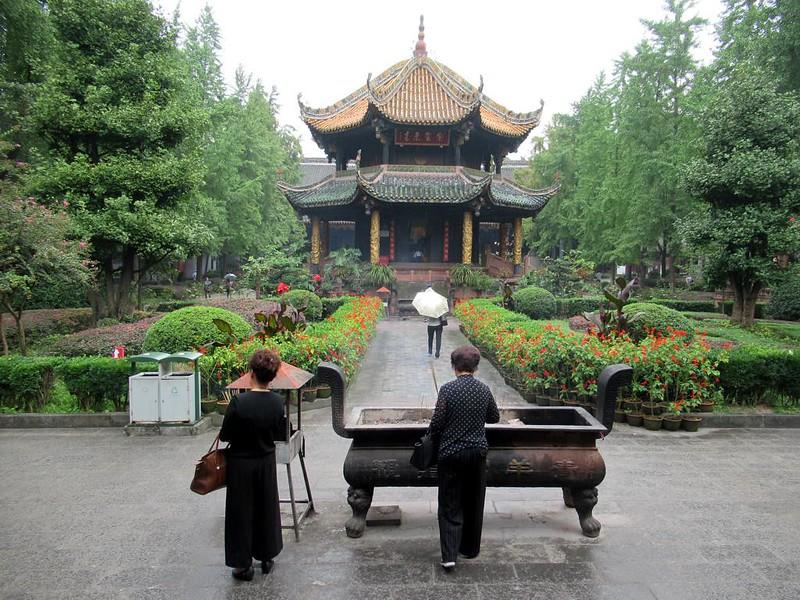

For all that China is thought to be irreligious, its Chinese people have long prayed to religious figures apart from Chinese belief systems and Chinese folk religion. Beyond Buddhism, or the practice of Taoism or, for that matter, praying at a Confucian temple such as the Temple of Heaven, Chinese people have always reposed faith in a vast array of Chinese deities and Chinese gods, like Yuhuang (Jade Emperor), Xiwangmu (Queen Mother of the West), the Chinese goddess of mercy, Doumu (Mother of the Big Dipper), and Caishen (god of wealth).
Long before China became a unified country, the country's 58 recognised ethnicities had a shared common history of the same Chinese mythology, Chinese folk tales and mystical beliefs as neighbouring tribes, rooted in ancient Chinese traditions dating back to the Shang Dynasty and recorded in sources like the Records of the Great Historian.
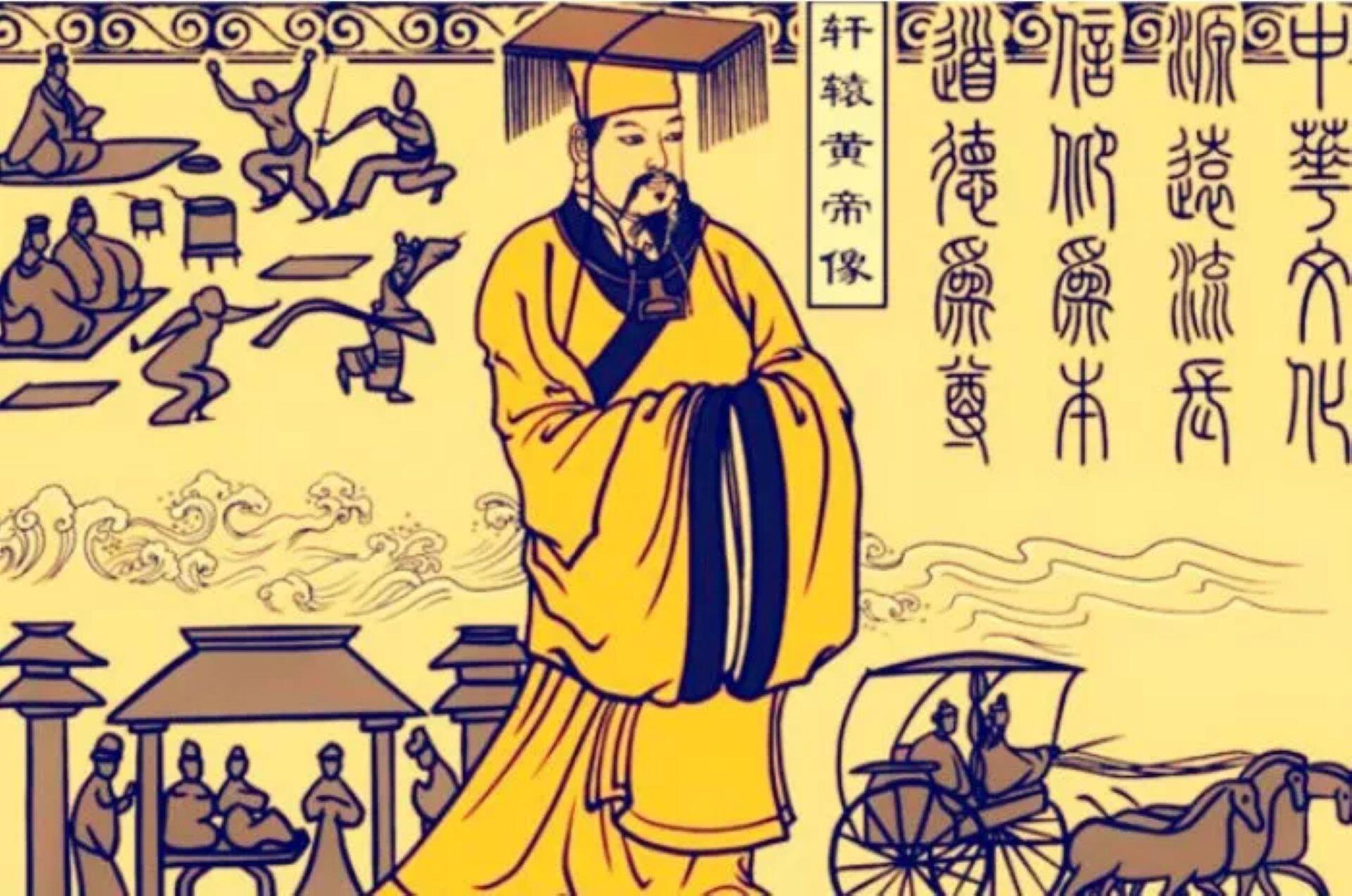
For example, the Yellow Emperor, a central Chinese deity associated with the Han Dynasty, is recognised as the emperor of all Chinese people, not just the Han Chinese, standing as a symbol of unity even during the Han’s efforts to overthrow the Qing Dynasty, regardless of the sovereign emperors. That's where Chinese mythology plays a unifying role. No matter the Chinese states at war, the invasions of Manchus, Mongols or western powers, or the transition from one dynasty to the next, their gods united them.
Key Takeaways
- Chinese mythology unites the ethnic groups of China through shared gods and deities.
- Chinese gods have human-like qualities like anger, loneliness and are relatable beings.
- Core creation myths mention how Pangu, Nuwa, and Fuxi created the world out of chaos and nothingness.
- Chinese mythology is a mixture of Buddhist, Daoist, and Confucian traditions.
- The pantheon of Chinese gods is vast, with each god assigned a particular role.
- Chinese mythology is an active part of Chinese life and continues to shape festivals, rituals, and popular media.


Understanding Chinese Mythology
To understand Chinese culture is to know how Chinese people commune daily with their gods. That's why learning about Chinese mythology is so important, especially about Chinese religion, folk religion, and Chinese folk traditions that remain visible today, even during Chinese New Year celebrations.
In Chinese mythology, even humans can become gods, provided they have led exemplary lives. The soul that enters Heaven via the "Silver Bridge" is reborn as a god and becomes part of Chinese mythology.
Unlike creation stories that are built around an omniscient, omnipotent, remote and disconnected figure who performed miracles, the ancient Chinese creation stories are built on characteristics of the human experience like loneliness and anger, and being overcome by natural phenomena like floods and fires.
Its gods are relatable but, more importantly, they are accessible and equitable--right from the Jade Emperor to the Chinese goddesses revered by the people.
In the beginning there was as yet no moral or social order. Then came Fuxi and looked upward and contemplated the images in the heavens, and looked downward and contemplated the occurrences on earth. He laid down the laws of humanity.
Ban Gu, ancient Chinese historian
Let us take a look at the origins of Chinese mythology and the key themes and concepts that govern it.
Origins and Evolution
It is believed that Chinese mythology originated around the twelfth century B.C.E. and was transmitted orally for over a thousand years before being recorded in books, such as the Shui Jing Zhu and Shan Hai Jing. Fengshen Yanyi (Investiture of the Gods) is another famous novel documenting the war between the Shang and the Zhou dynasty and incorporating elements from Chinese folk religion, Chinese mythology, Taoism, Buddhism, and Confucianism.
While certain gods like the Jade Emperor or Pangu have their origin in Chinese mythology, there were others, like Confucius, who were historical figures who were later deified, showing the blend of Chinese mythology and history in their religious practice.
Key Themes and Concepts
1. Yin and Yang
In Chinese mythology, yin and yang were born from chaos, coexisting in harmony at the centre of the earth. It was this balance within the cosmic egg that led to the creation of Pangu—the first human. In Daoism, Yin and Yang symbols represent the interaction of opposites required for existence, encouraging us to go with the flow instead of resisting change and accept things for what they are.
- Without Yin energy, nothing can come into existence
- Without Yang, nothing can go out of existence
In the I ‘Ching, Yin is represented by a broken line, and Yang is represented by a solid line.
2. Creation Myths: Birth of Pangu, Nuwa and Fuxi
It is said that long, long ago, the universe was a shapeless void. From that chaos emerged Pangu, a colossal being who gestated inside the egg for 18000 years before breaking free. Upon awakening, he separated Yin and Yang, forcing the heavens to rise and the earth to fall. When he died, his breath became the wind, his blood the rivers, and his eyes the sun and moon.
There are temples dedicated to Pangu, the most famous being the Pangu King Temple 盤古皇廟 (Pángǔ huáng miào) in Huadu District, Guangdong Province.
Other versions credit Nuwa, the mother-goddess and Fuxi as the creators of the human race. Feeling lonely, she shaped human figures from yellow earth, creating for herself a family of dolls. These clay dolls became her first children. Unable to make everyone by hand, she raked the yellow earth with a string, creating more people—those people she moulded became nobles, while the rest became commoners.
There is an interesting story behind the birth of Nuwa and Fuxi. According to legend, Nuwa and Fuxi were born to goddess Huaxu, who, one day, when walking, accidentally stepped on the thunder god’s footprint and became pregnant.
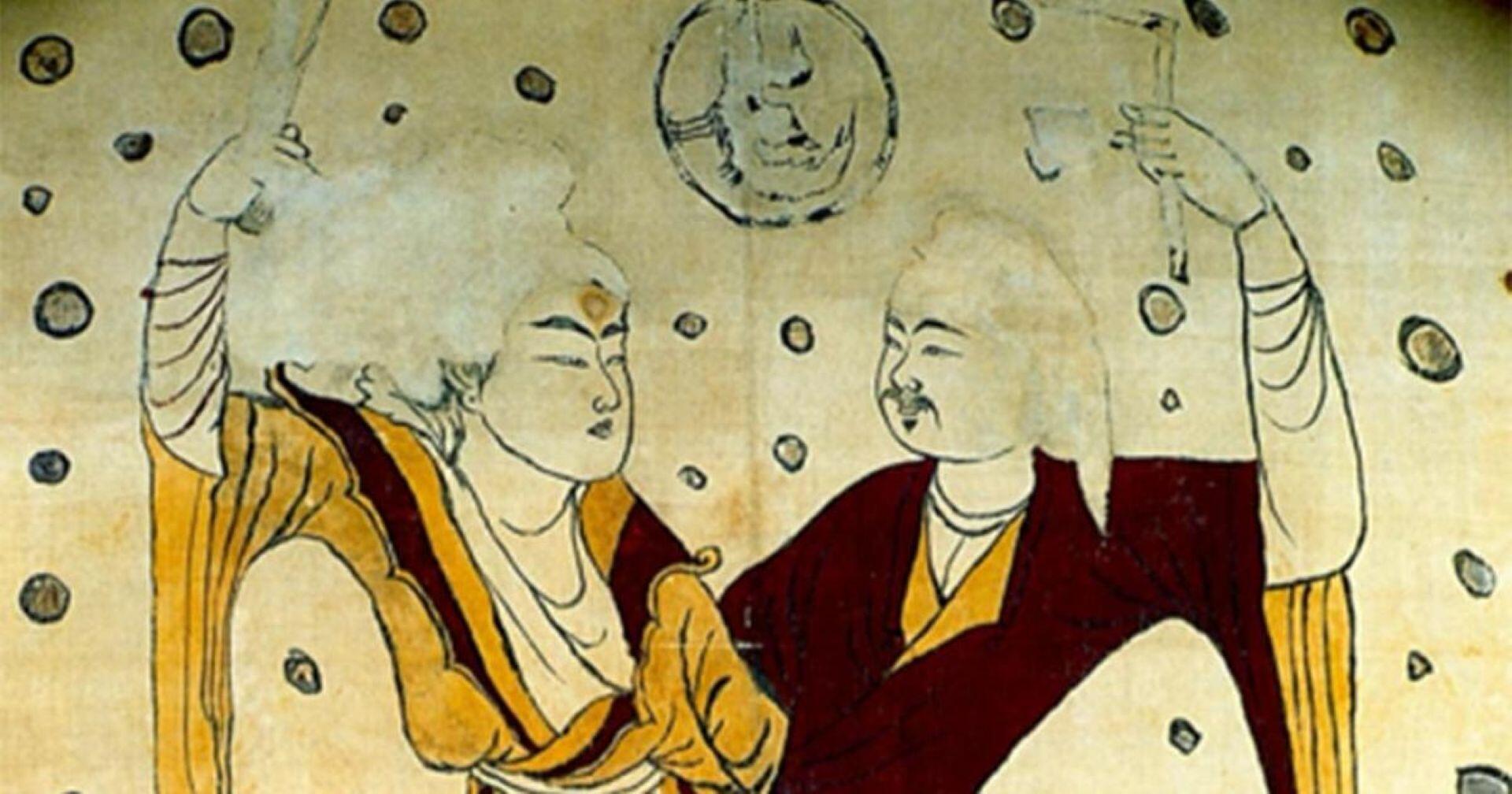
Nuwa is credited with repairing the Pillars of Heaven after the pillars collapsed, causing all manner of disaster and tragedy to unfold. Nuwa first patched up heaven and then cut the legs off of a giant turtle to hold up the sky. She also killed the black dragon that was tormenting the people of Ji and built dams to halt the floods.
Similar to Nuwa, Fuxi is often portrayed as having a human’s head and a snake’s body. He’s also depicted as a wise sage dressed in animal skins and flowing long yellow robes.
Fu Xi is believed to have lived for an extraordinary 197 years, and legend says he is buried in Huaiyang, Henan Province. Visitors can still visit his tomb today to pay their respects to the first ancestor of humankind.
Fuxi is credited with several innovations benefiting humanity, like:
- Creation of the bagua or eight trigrams
- Inventing the writing system
- Domestication of animals
- Fishing and trapping
3. Role of Immortality
Immortality is another central theme in Chinese mythology. Rulers in ancient China sought favours from gods and goddesses to attain immortality. In Daoism, immortality is seen as the ultimate goal, as it represents spiritual harmony with the Dao. The immortal beings are known as Xian and symbolise the connection between the divine and the earthly realm. Symbols like the "Peaches of Immortality", the "Lotus", the "Crutch", and the "Gourd" are not just mere symbols but carry a lot of weight in Chinese mythology.
Major Deities in Chinese Mythology
The Jade Emperor (Yu Hwang)
The Jade Emperor, a fount of supreme authority and wisdom, is a revered figure in Chinese mythology. He is regarded as the ruler of Heaven who presides over a court of important deities.
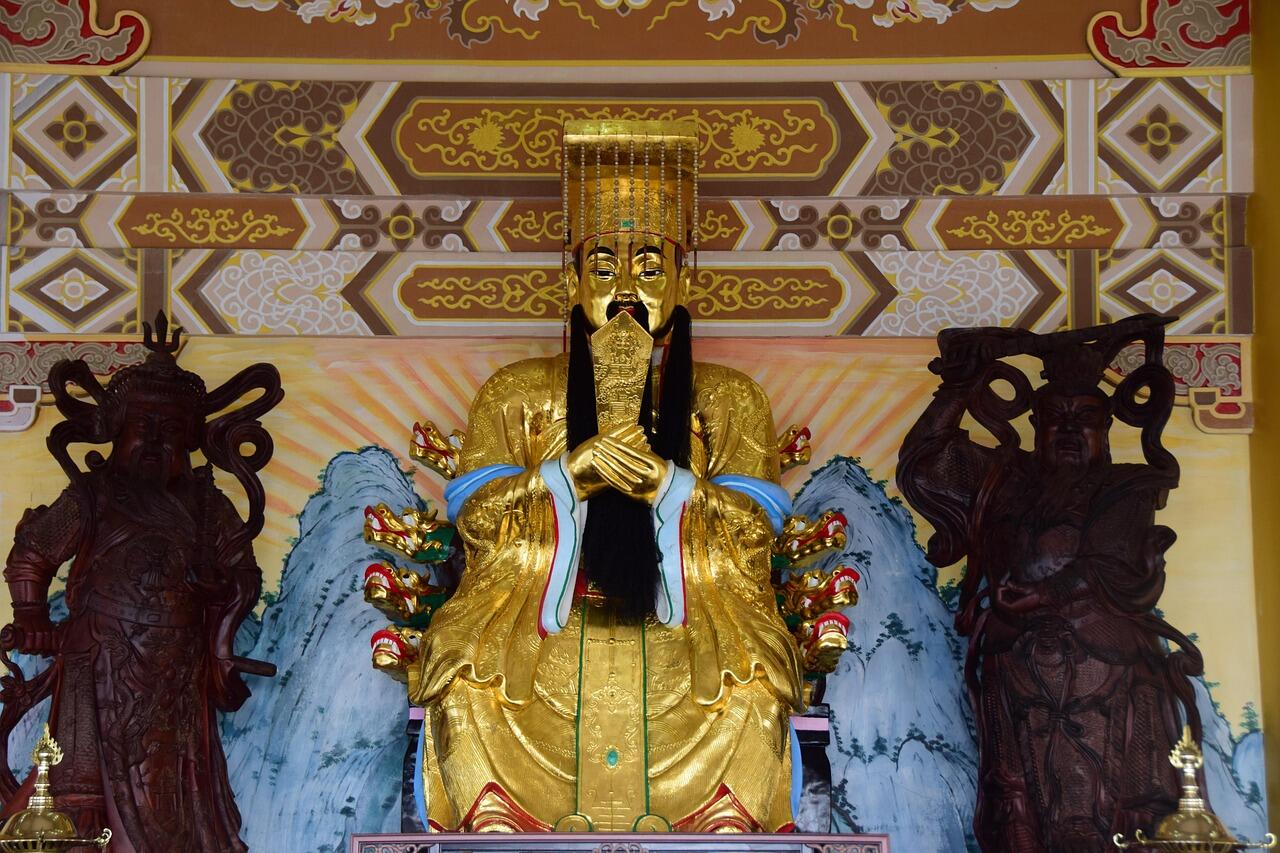
The Jade Emperor’s administration is divided into bureaus just like that of an earthly administrative office, where each god is in charge of a particular domain. Several gods report to him, namely:
- The Four Heavenly Kings
- Cosmic deities (Big Dipper Gods)
- Administrative gods (City Gods and Earth Gods)
- Household gods (Kitchen Gods and Door gods)
The Jade Emperor is a vegetarian. But, despite this, devotees bring animal sacrifices because they believe that their guests would enjoy the food.
The Eight Immortals (Ba Xian)
The Eight Immortals are popular Chinese deities who play a vital role in Chinese religion. Like other Taoist gods, most Immortals are actual historical individuals, born in the Tang Dynasty or Song Dynasty, and elevated to immortal status through personal piety, trickery or luck. They are usually depicted as a group and rarely individually.
They are:
Zhongli Quan – He is the senior-most member of the group and is depicted as an aged and obese man. He is thought to have attained immortality through his alchemical prowess.
Lü Dongbin – According to The Eight Immortals Achieving the Tao, in a previous incarnation, Lü Dongbin was a Taoist master who served as the teacher of Zhongli Quan.
Li Tieguai (Iron-Crutch Li) – An ascetic who was known for his astral journeys and his compassionate nature.
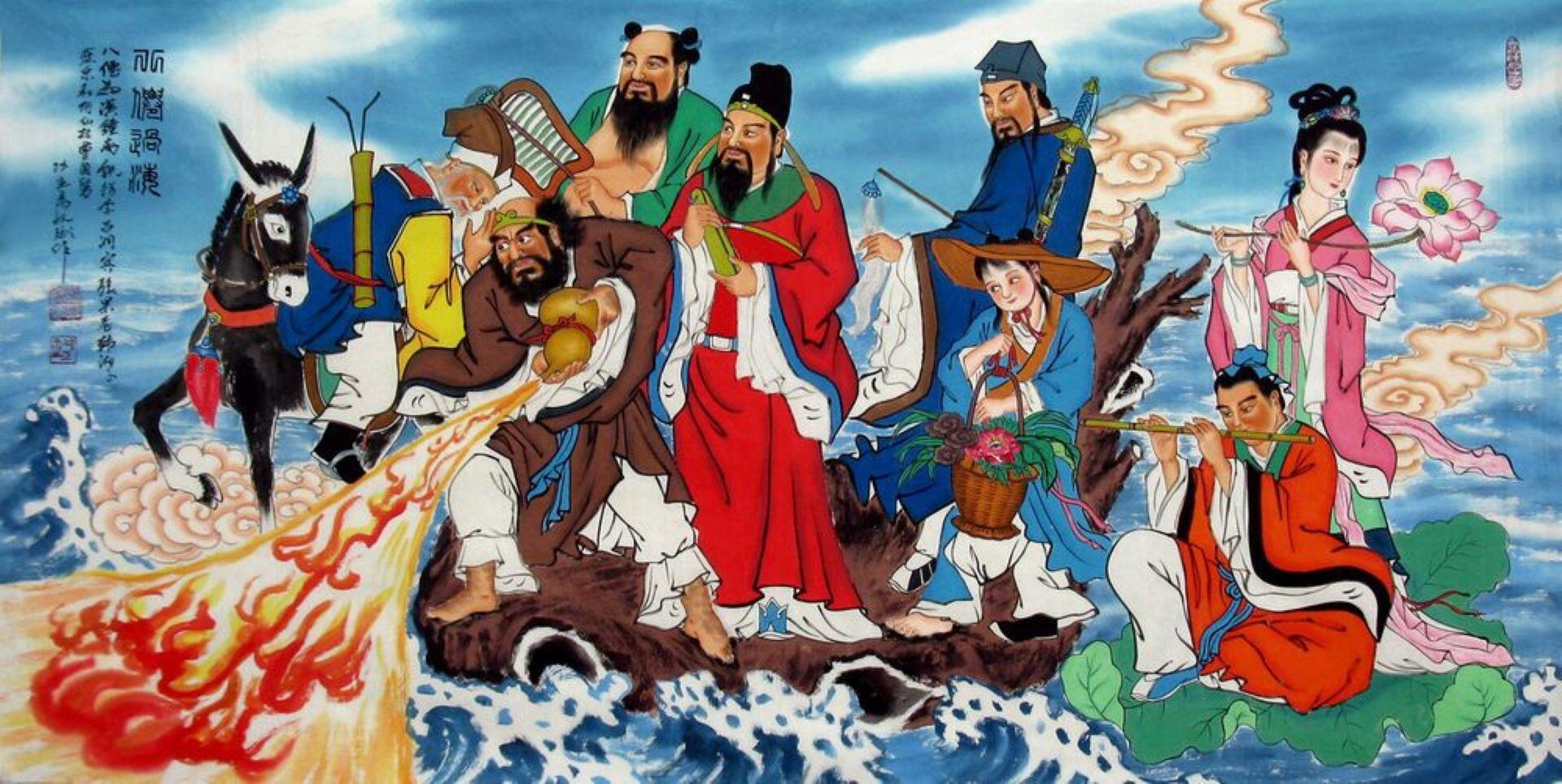
He Xiangu - He Xiangu is the only woman in the Eight Immortals group who was granted Immortality as a divine gift for her purity.
Lan Caihe - An androgynous street performer known for their carefree nature. Renowned for their kindness towards the poor.
Cao Guojiu – The patron deity of acting is portrayed as a noble figure dressed in court regalia.
Han Xiang Zi – Also known as the “Philosopher Immortal”, Han Xiang Zi is shown carrying a flute and is dressed in green.
Zhang Guolao - The clown of the group who rides a donkey backwards.
Nezha
Nezha (pronounced Nuh-ja) is a famous deity in Chinese mythology whose origin can be traced to the Indian deity Nalakuvara. Believed to be the patron saint of young adults, Nezha represents free will and self-determination.
Nezha was born to General Li Jing and his wife, Lady Yin, who had been childless for a long time. Finally, after many years, Lady Yin became pregnant. However, it was an extraordinary pregnancy as she carried the child for three years and six months in her womb before giving birth to a glowing ball of flesh. Fearing it was a demon, Li Jing struck it with his sword, upon which the ball split open and Nezha emerged as a fully formed boy endowed with divine powers.
Here is an overview of the famous Five Artifacts of Nezha.
Artifact
- Qiankun Ring
- Huntian Cloth
- Golden Brick
- Fire Tip Spear
- Nine Dragon Holy Fire Cover
Purpose
- A golden wrist ring and Nezha's most favourite
- A red cloth used to bind his enemy
- Used to throw at opponents
- A red spear
- A bell-shaped cover and very powerful
His popularity is immense, with a film made on him shattering multiple global box office records and raking in over US$1 billion (S$1.34 billion) in China in just one week.
Categories of Chinese Deities
Gods of Heaven and Celestial Phenomena
Tian
Tian is a god who rules over lesser gods and human beings. In direct contrast with Shang Di, Tian takes no human form. Literally translated, Tian refers to “heaven,” while Shang Di refers to the Supreme Ancestor. Over time, at some point in ancient history during the Zhou dynasty, the line separating Shang Di and Tian blurred to the point that referring to Tian implied the celestial father. For a time, they were both worshipped as a single entity; thus, the inspiration for the Temple of Heaven in Beijing.
Star Lords
In Chinese mythology, there are three Star Lords:
- Fuxing (happiness) - Portrayed as a man in a scholarly dress, holding a stack of books
- Luxing (material fortune) - Represents rank and prestige and is primarily worshipped for success in the Imperial examinations.
- Shouxing (longevity) - Known as the “Old Man of the South Pole,” and is said to preside over longevity.
Together, they are referred to as Sanxing and are often depicted as three bearded sages.
Shouxing's mother carried him in her womb for ten long years. And finally, when he was born, he emerged as a fully grown old man with white hair and a long, domed forehead. This was regarded as a sign of divinity, and he came to embody longevity and long lifespans.
However, surprisingly, there are no temples dedicated to Shouxing! Instead, his paintings and statues are commonly found in homes, where people pray to them for a long life.
Gods of Earth and Nature
Dragon Kings
In China and large parts of Southeast Asia, the dragon is a sacred creature possessing a wide range of supernatural abilities and is known to rule the seas, rivers, lakes, and clouds. It is believed that the Goddess of Creation (Nü Wa) assigned four dragons to administer the Four Seas.

They are:
- Ao Guang of the East Sea is linked to spring
- Ao Qin of the South Sea is linked to fire and summer
- Ao Shun of the North Sea is linked to water and winter
- Ao Run of the West Sea is linked to metal and autumn
The Dragon Kings are decked in regal attire and take instructions from the Jade Emperor.
Tudi Gong
Tu Di Gong is a benevolent Earth God who protects the land and the people who live within it. In the Five Elements, earth generates gold and treasure. Due to this, Tu Di Gong is worshipped as a harbinger of prosperity and is favoured by those seeking to enhance their wealth, luck and overall prosperity.
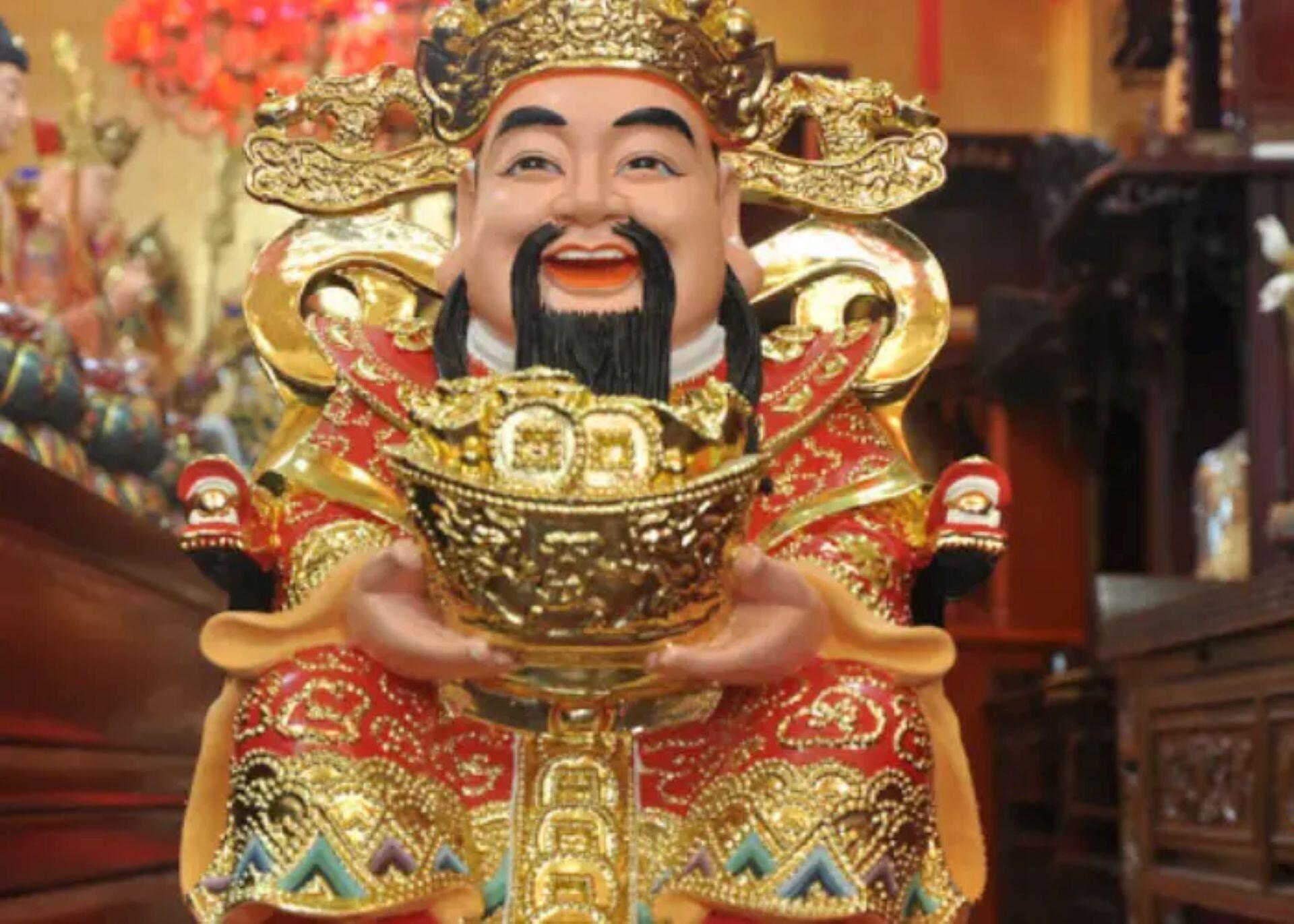
He is artistically shown sitting on a dragon throne, holding a gold ingot and Ruyi sceptre—both symbols of emblems of abundance and good fortune.
Gods of Human Virtues and Professions
Caishen
If you have ever witnessed a Chinese New Year celebration, you would have seen a god wearing a red dress. That god is none other than Caishen, the God of Wealth in Chinese belief systems. In Taoist belief systems, Caishen is one of the most popular involved deities. He is shown riding a black and white tiger and carrying a cudgel and a golden rod. The cudgel has the power to turn even a simple rod into gold.
Comprehensive List of Chinese Mythology Gods
Although Chinese tradition features over a thousand deities, its pantheon is comparatively less when compared to Greek, Roman, or Egyptian mythology. Many Chinese mythology gods originated as folk heroes rather than cosmic beings, and their stories tend to involve fewer extravagant feats or superhuman powers.
Unlike other mythologies with intricate divine family trees, Chinese mythology has almost no genealogical hierarchy—Shangdi, the supreme heavenly god, fathers no one, and roles are generally clear and purposeful. Even Nuwa’s marriage to her brother, intended to repopulate the earth, reflects a defined cosmological function, in contrast to the tangled and often lust-driven relationships seen in other mythic traditions.
Major Deities
The 5 main foundation deities are:
- Shang Di: the supreme emperor, often referred to as the god in heaven (he's not represented as a being in the literature)
- Tian: a formless entity representing the sky and/or heaven (in Mandarin, Tian means 'sky')
- Pangu: the first sentient being in Chinese mythology
- Nuwa: the mother of all humanity, considered a supreme goddess
- Huang Di: the Yellow Emperor, considered the first ruler and proof that all emperors rule by divine right.
Here is a list of the major Chinese mythology gods.
| Major Deities | Role | Significance |
|---|---|---|
| Pangu | Creator of the universe | Separated heaven from earth and his body transformed into the elements |
| Nuwa | Creator of humanity | Repaired the broken sky |
| Jade Emperor | Ruler of Heaven | Administrator of gods, humans, and spirits |
| Shangdi | Supreme sky deity | Oversees destiny and cosmic order |
| Fuxi | Originator of civilization | Invented the Bagua |
| Caishen | God of Wealth | Said to bring prosperity and worshiped during the Lunar new Year |
| Chang' e | Moon Goddess | Symbol of love and immortality |
Minor Deities
In addition to major deities, there are several minor Chinese mythology gods. They are:
Gods
- Door Gods
- Kitchen God
- Well God
- Earth God
- City God
- Bed God
- God of Agriculture
Function
- Protects homes from bad spirits
- Watches over household matters
- Protects water sources
- Oversees land and villages
- Protects cities
- Helps women during childbirth
- Ensures good crops and harvest
Summarise with AI:
Did you like this article? Leave a rating!

 Loading...