

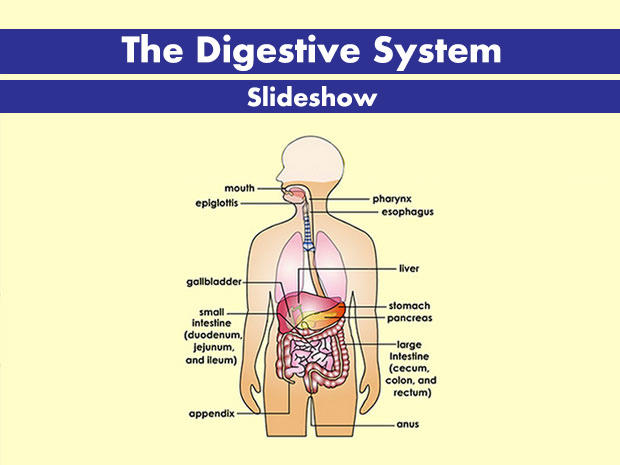
The human digestive system involves digestion, absorption, assimilation and defecation processes. It consists of a long and muscular alimentary canal. It starts from the mouth to the anus. The alimentary canal parts include:
- Mouth
- Esophagus
- Stomach
- Small intestine
- Large intestine
- Anus
There are also other organs involved in the digestive system:
- Liver
- Gallbladder
- Pancreas
These glands are responsible to secrete digestive juices into the alimentary canal:
- Salivary gland
- Gastric gland
- Intestinal gland


What is digestion?
Digestion is the process that breaks down large and complex pieces of food into smaller and simple pieces that can be dissolved for easy absorption. There are two types of digestion:
1. Physical Digestion
- The mechanical breakdown of food forms small particles that involve chewing and peristalsis.
2. Chemical Digestion
- The decomposition process of complex molecules into simple molecules that involve enzymes reactions.
How does the digestion process work?
Previously, you already learned about the human digestive system in Science form 2. However, in Biology form 4, you will have more in-depth details about this topic.
There are 3 steps in the digestive process:
1. Digestion of carbohydrates in the mouth
The digestive process starts in the mouth. Salivary glands secrete saliva when they sense the presence of food in the mouth. Saliva consists of salivary amylase that hydrolyses starch to maltose.
The function of saliva is to help food form bolus to make it easier to be swallowed. During the swallowing, the epiglottis closes the trachea opening in order to avoid the food from entering the trachea.
In the esophagus, the food bolus is moved by peristalsis. Peristalsis is the rhythmic contraction and relaxation of muscles along the alimentary canal. It pushes the bolus through the esophagus until it enters the stomach.
Digestion of proteins in the stomach
The surface of the stomach is full of epithelial cells. They consist of:
- Chief cells that produce pepsinogen
- Pepsinogen is an inactive enzyme that is activated by hydrochloric acid to become pepsin.
- Pepsin hydrolyses proteins into polypeptides.
- Parietal cells that produce hydrochloric acid
- Hydrochloric acid prepares a medium with a suitable pH for pepsin to act.
- It also stops the enzymatic action of salivary amylase and kills bacteria in food.
- Mucous cells that produce mucus
- Mucus protects the stomach wall from the reaction of hydrochloric acid and digestive enzymes.
The food in the stomach is mixed with gastric juices produced by the gastric glands. Through the peristaltic action of the stomach muscle, food is churned off.
The content of the stomach changes into a semifluid called chyme. It enters the small intestine slowly when the sphincter muscles relax.
Digestion of carbohydrates, proteins and lipids in the small intestine
The small intestine consists of:
- Duodenum
- The first part of the small intestine receives chyme from the stomach.
- It also receives bile that is produced by the liver, as well as pancreatic juice secreted by the pancreas.
- Jejunum
- It is located in between the duodenum and ileum.
- It helps to further digest food that is coming from the stomach.
- Ileum
- The glands on the ileum wall secrete mucus and intestinal juice that contains maltase, sucrase, lactase, lipase and pepsin.
- The alkali medium in the ileum allies enzymes to act at its optimum.
You can refer to these three steps in the form 2 science textbook. You may want to keep Science form 2 all chapters' notes as they will be useful for your Biology form 5 and form 4 studies. You can also use science form 3 and form 4 science textbook as revision books.
How does food get absorbed to the body?
Once the food is digested in the mouth, stomach and small intestine, the simple molecules produced are absorbed in the ileum. The ileum is able to absorb nutrients because of its internal layer.
The ileum internal layer is folded and covered by tiny projections called villus. Villus (or villi in plural form) has:
Epithelial Layer
- Helps to accelerate nutrient absorption
Goblet Cells
- Secrete mucus to aid digestion.
Network of Blood Capillaries
- Helps to transport digestive products to the whole body.
Lacteal
- Carries droplets of fatty acids and glycerol.
Intestinal Glands
- Secrete intestinal juices that contain digestive enzymes.
On the surface of the villus epithelium, you can find many tiny projections called microvillus, the function of the microvillus is to increase the rate of nutrients absorption.
How does the body assimilate food nutrients?
Assimilation is the process of absorbing nutrients during digestion and distributing them to the body for growth and repair. Nutrients are assimilated by the human circulatory system that consists of:
- The blood circulation system
- The lymphatic system
Liver function in the assimilation process
The liver is one of the most important organs in the assimilation of digested food. It acts as a regulator that controls the number of nutrients that enter the blood circulation system. The function of the liver in the assimilation process is:
Metabolism of digested food
- Excess amino acids are turned into urea through the deamination process.
Detoxification
- Liver cells expel toxic substances from the blood.
- Toxic substances are expelled through the urine.
Storage of nutrients
- Excess glucose is converted to glycogen and stored in the liver.
Assimilation process in the liver
Amino acids
- The liver synthesis, plasma, proteins, and enzymes form amino acids.
- Excess amino acids are broken down through the deamination process and expelled in form of urine.
- When the glucose supply is insufficient, the liver converts amino acids into glucose.
Glucose
- Glucose is used for cellular respiration.
- Excess glucose is converted to glycogen and stored in the liver.
- When the level of glucose in the body decrease, glycogen is converted into glucose.
- When the glycogen supply exceeds the maximum level, it is converted into fats.
Assimilation process in cells
Amino acids
- Used to synthesis new protoplasm and also to repair damaged tissues.
- Used to synthesise hormones and enzymes.
Glucose
- Is oxidized through cellular respiration to release energy, water and carbon dioxide.
- Excess glucose is converted into glycogen and kept in the muscle.
- Energy is used for cell processes.
Lipids
- Are the primary components that build the plasma membrane (phospholipid and cholesterol).
- Excess fats are kept as energy in adipose tissues found underneath the skin.
- Fat is oxidized to release energy when the glucose is insufficient.
What is defecation?
Defecation is the process of discharging feces from the body. After nutrients are completely absorbed into the ileum, the undigested food, dead cells, epithelial cell, fibre and water move slowly to the large intestine.
Large intestine functions
The large intestine has two main functions in the defecation process:
1. The absorption of water and vitamins
- Absorbs water and mineral salts.
- Absorbs metabolic byproducts of some bacteria, such as vitamin B, vitamin K and folic acid.
2. The formation of feces
- After the water and vitamins are absorbed in the large intestine, the remaining wastes, called feces, are processed.
- The walls of the large intestine secrete mucus to smoothen the movement of the remaining waste until the anus.
- The movement of the feces takes about 12 to 24 hours to enter the rectum.
- The feces will be accumulated in the rectum until the pressure in it increases.
- The rectum muscle contracts to expel feces from the anus.
What are the health issues related to the digestive system and eating habits?
One of the highest health issues on the rise is obesity. It is true that obesity can be controlled through special diet management and routine exercise programmes. However, there are some patients that require special medical treatment.
In order to reduce body weight, some specialists suggest surgical procedures like gastric bypass. Gastric bypass is a surgical process that involves a reduction of the stomach size.
Apart from obesity, there are many other health issues related to the digestive system. The problems may occur due to digestive system impairment, eating disorders or genetically inherited.
The form 3 English textbook mentioned parents passing down genes to their offspring and the offspring take after the parents' looks or characteristics. But it does not remark anything about passing down diseases.
Health issues related to defecation
- Constipation
- Colon cancer
- Rectum cancer
- Hemorrhoids
Health issues related to eating disorders
Eating habits also play an important role in our energy consumption. An imbalanced diet and poor eating habits cause these health issues:
Gastritis
- The inflammation and corrosion of the stomach epithelial layer.
- This is mainly caused by gastric juice when there is no food in the stomach.
- This condition can be caused by eating irregular quantities of food in irregular hours and also excessive intakes of alcohol and painkillers.
- Untreated gastritis may lead to gastric ulcers.
Anorexia Nervosa
- This eating disorder is common amongst females who are obsessed with their body weight and appearance.
- Anorexics avoid eating in order to achieve their ideal weight.
- People who suffer anorexia have psychological problems and nutrient deficiency because their normal digestive system is affected.
Bulimia Nervosa
- People with bulimia nervosa are also obsessed with their body.
- Contradict to anorexia, these people eat a lot of food and then force themselves to vomit all the food they took before.
- They also may take laxatives that cause diarrhea.
- They suffer from dehydration, nutritional problems and cardiovascular disease or kidney failure in the long term.
Muscle Dysmorphia
- People with muscle dysmorphia issues feel that their body size is too small.
- They tend to consume steroids or muscle building supplements.

Bio-life terms of the nutrition and human digestive system chapter may confused you a bit. The same goes for other topics such as variation. Furthermore, there are so many things about bio-life to remember... Fear not! Here is where a tutor can lend you help.
A Biology tutor can help you to learn the Biology subject much better, especially the tough topics, such as biodiversity.
But, where to find a tutor with a Biology background? In Superprof, of course.
Superprof is an online tutoring website where you can find a home tutor online to teach you about any subject. You can look for ‘tuition near me’ or search for other professional tuition Malaysia.
Did you know that you can go for either an online learning session or a physical one-to-one lesson with your Superprof tutor? Choose whatever option that suit you the best and get prepared for your SPM Biology on human reproduction topic.
Summarise with AI:
Enjoyed this article? Leave a rating!

 Loading...
