
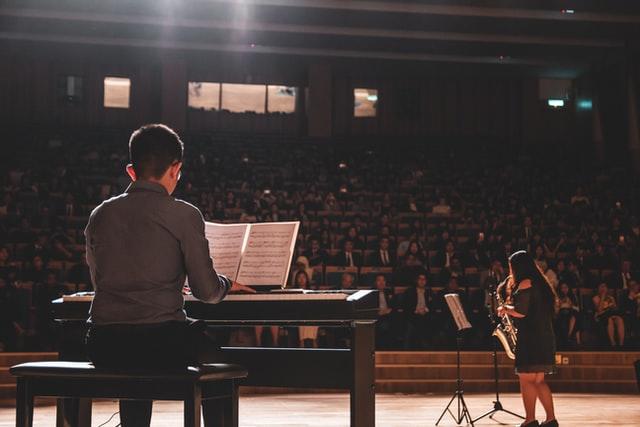

As cliché as it sounds, the only way to reach the top is to start from somewhere.
It's important to know where your end goal is and how to reach there step by step successfully.
As you're reading this, you could be a parent of a young child who shows great interest in learning the piano or someone who is already learning the piano.
You may wonder about your present stage or wonder how long will it take for you to reach a high level in learning the piano.
In this article, we'll go through the 5 steps for you to take your piano skills to the next level.


Step 1: Enrol In Basic Beginner's Piano Lessons
If you're preparing for your child's first piano lesson or even your own lesson as a newbie, here are 3 basic elements that you will cover throughout this step.
- Posture
Do not underestimate the importance of having the right posture. It will help you to have a smooth process of reading the piano scores and flexing your fingers back and forth on the keyboard without any technical difficulties.
- Fingering
Knowing how to place your fingers and move them at the right turn will help you when you are playing different songs and scales in the future, especially when the piece requires you to be playing at a faster pace.
- Recognizing piano and sound notes
From identifying the middle C note on the keyboard, memorizing all the music notes and correctly playing them while reading the scores, is a significant key to identifying whether you are ready to "graduate" from your beginner's lessons.
By the end of your piano beginners' lessons, you should be able to smoothly play at last one simple song on both hands in the right posture.
Learn from an experienced piano tutor from Superprof
The process of looking for a piano tutor can be quite tedious when there's so many options to choose from.
Fancy a platform that we help you to find the right piano tutor through an effective filtering system?
If you've just said yes, then you should also say yes to Superprof!
At Superprof, you can easily find a piano tutor near you who can offer you personalised lessons according to your needs and preference.
You can find a piano tutor that fulfils these criteria:
- Located near your city
- Open to online lessons
- Offers piano lessons for all learning levels
- Uses a creative teaching methodology
- Has many years of teaching experience
- Has experience as a concert pianist
- Offers an hourly rate that is within your budget (you get to set your maximum budget during the filtering process)
All this information will be listed on every tutor's profile and you can easily review them during your browsing session. If you are satisfied, you can then proceed to get in touch with the private tutors at Superprof and discuss the details of your lessons.
Find out if it's crucial to start learning piano at a young age.
Step 2: Take ABRSM Practical And Theory Piano Lessons
After completing the piano beginner's lesson, it's time to prepare for your Grade 1 lesson.
Students are encouraged to sit for the ABRSM exam because it provides you with a systematic guide to track their progress as you keep up with a consistent learning routine.
As you will be evaluated on various components (both theory and practical) in different grades, you will get to develop your piano playing techniques in a comprehensive manner. Let's also not forget the certificates that you will get after you have passed your exams, which serve as proof of your hard work and skill.
Let's take a look at what you need to prepare for the exams.
ABRSM Practical Piano Exam Scope
This applies to all grades [Grade 1 to Grade 8]. The complexity and difficulty level of the syllabus will increase with each grade.
- Candidates will select three examination pieces from 3 lists
- Candidates will need to play scales and arpeggios (legato) from memory
- Candidates will be given a short piece for sight-reading
- Aural tests will be given by examiners (to develop the musical ear)
ABRSM Music Theory Exam Scope
From Grade 1 to Grade 5, candidates will sit for an online objective assessment and will be tested on these elements:
- Rhythm
- Pitch
- Keys and scales
- Intervals
- Tonic Triads
- Terms and signs
- Music in Context
Photo by Kelly Sikkema on Unsplash
From Grade 6 to Grade 8, candidates will sit for a paper-based assessment and will be given five extended questions to answer, in which 3 questions will revolve around the topic of Creativity in Harmony and Melody and 2 questions about Music in Context.
Step 3: Sit And Pass The Exams For Each Grade (From Grade 1 to Grade 8)
Through consistent practice and guidance in between your lessons, your music teacher will monitor your learning level and then ask you to register for your ABRSM examination once he or she thinks you're ready.
Now, let's review the marking criteria for each exam.
For ABRSM Practical Exam [Applicable for Grade 1 to Grade 8]
This is how the practical exam is graded. The total mark is 150.
- Distinction [130 marks to 150 marks]
- Merit [120 marks to 129 marks]
- Pass [100 marks to 119 marks]
You will be tested on three components: piano piece, scales, arpeggios and sight-reading as well as an aural test.
For the piano pieces component, each candidate will be evaluated based on five criteria namely:
- Pitch
- Time
- Tone
- Shape
- Performance
| Mark Range | Grade |
|---|---|
| 0 | No grade |
| 10-12 | Below pass |
| 13-16 | Below pass |
| 17-19 | Below pass |
| 20-23 | Pass |
| 24-26 | Merit |
| 27-30 | Distinction |
For the scales, arpeggios and sight-reading component, this is the grading scale.
| Mark Range | Grade |
|---|---|
| 0 | No grade |
| 7-10 | Below pass |
| 11-13 | Below pass |
| 14-16 | Pass |
| 17-18 | Merit |
| 19-21 | Distinction |
For the aural tests component, this is the grading scale.
| Mark Range | Grade |
|---|---|
| 0 | No grade |
| 6-8 | Below pass |
| 9-11 | Below pass |
| 12-14 | Pass |
| 15-16 | Merit |
| 17-18 | Distinction |

Photo by Gabriel Gurrola on Unsplash
For ABRSM Music Theory Exam
For Grade 1 to Grade 5, the full mark is 75.
- Distinction [65 and above]
- Merit [60 to 64]
- Pass [50 to 59]
For Graded 6 to Grade 8, the full mark is 100.
- Distinction [90 and above]
- Merit [80 to 89]
- Pass [66 to 79]
Examination Tip: It's EXTREMELY IMPORTANT to pass your Grade 5 Theory exam in order to sit for your subsequent grades' (Grade 6 to Grade 8) practical exams.
Learn more about the salary of a professional pianist in Malaysia.
Step 4: Register For An Advanced Diploma After Passing Your Grade 8 Exam
Let's say you have passed your Grade 8 ABRSM exams, you are now given the option to either continue with an ABRSM diploma or wait until it's time to go for a foundation/undergraduate music degree after your secondary school education.
There are 3 ABRSM diplomas that lead to different specialisations.
If you are keen to teach piano one day, then you should register for the Instrumental Teaching Diploma.
If you are more inclined towards performance (like becoming a concert pianist), then you should consider taking the Music Performance Diploma.
If you desire to work in an orchestra and become a music director, then you should pick the Music Direction Diploma.
You can find out the latest examination syllabus and requirements for all the listed ABRSM diplomas on their official website.
Have an overview of the journey to becoming a professional pianist in Malaysia.
Step 5: Major In An Undergraduate /Postgraduate Programme in Piano or Music
Congratulations, you have reached the final step to studying piano at a high level in Malaysia! All that's left is a university programme.
You can opt to study music/piano at a public or private learning institution. You can refer to the list below to understand more about pursuing music at the tertiary level in Malaysia.

Source: Xframe
Public universities
- Universiti Malaya (UM)
Among the programmes that you can take at UM is the Bachelor of Music and Master of Performing Arts (Music).
The entry requirements for the degree include: Candidates must have at least a Grade 5 ABRSM Certificate, get Band 2 for the Malaysian University English Test (MUET) and pass the audition plus interview. The degree is 3 years.
The degree will focus on these four key areas:
- Performance
- Composition,
- Ethnomusicology
- Education
- Universiti Putra Malaysia (UPM)
Students can enrol for the Bachelor of Music at UPM after passing the audition and fulfilling the academic requirement. This degree is also 3 years long.
Among the subjects taught throughout the degree are:
- Music Language
- Music Awareness
- Music Writing Skills
- Research in Music
- Musicianship and many more
Private universities
- UCSI University
You can either choose to take the Bachelor of Classical Music or the Bachelor of Contemporary Music at UCSI University. Applicants need to pass a performance audition before the beginning of the semester.
The performance audition duration is 15 minutes and applicants are required to perform 3 pieces of contrasting styles and later sit for aural diagnostic tests as well as theory diagnostic tests.
Among the core subjects for Bachelor of Classical Music are:
- Music Research Methodology
- Chamber Music Ensemble
- Collaborative Piano
- Class Piano and many more
Some of the core subjects that you will learn in Bachelor of Contemporary Music are:
- Modern Band
- Jazz Music History
- Music Production Techniques
- Music Theory and many more
The duration for both of these programmes is 3 years.
- Sunway University
The music programmes that are offered at Sunway University include the BA (Hons) in Music Performance and the Bachelor of Arts (Honours) in Contemporary Music (Audio Technology). Let's take a look at the difference between these two degrees. The duration of the programmes is also 3 years.
The BA (Hons) Music Performance is for those who already have a solid background in music performance and music theory and those who aspire to become a performer and a musician.
On the other hand, the Bachelor of Arts (Honours) Contemporary Music (Audio Technology) is a combination of technical and creative elements, whereby graduates will usually venture into music production, sound and audio technology industry.
Explore various piano-related career options upon your graduation here.
We hope you will achieve your end goal and experience the delight that music brings to you throughout each step of your piano learning journey.
Every master was once a beginner. Every pro was once an amateur.-Robin Sharma.
Summarise with AI:
Did you like this article? Leave a rating!

 Loading...
