


A complete guide to SPM Malay—are you hoping for one that finally breaks everything down for you and allows you to study better?
The Sijil Pelajaran Malaysia examination can feel overwhelming, especially since Bahasa Melayu is one of the core subjects you must pass to obtain your certificate, alongside Sejarah (History). This certificate plays a crucial role in unlocking future opportunities, from applying to local universities to pursuing international education options. Whether you are aiming for a solid pass or an A+, the most important thing is to get your BM strategy right.
But you're not alone in this. In this guide, you'll find practical tips, real examples, and links to in-depth articles covering every aspect of the Malay subject. If you're a Malaysian student or a parent supporting your child's education, this Superprof guide is designed to assist you in navigating your preparation with clarity and confidence.
Are you ready to dive in? Let's get started. 📚
| Paper | Code | Skill Tested | Time | Marks | Key Sections |
|---|---|---|---|---|---|
| Kertas 1 | 1103/1 | Writing (Kemahiran Menulis) | 2 hours | 100 | Bahagian A: 30 marks (stimulus-based); Bahagian B: 70 marks (essay, choose 1 of 4) |
| Kertas 2 | 1103/2 | Reading and comprehension (Kemahiran Membaca) | 2 hrs 30 mins | 100 | Bahagian A: 35 marks (grammar and language system); Bahagian B: 35 marks (comprehension and literature); Bahagian C: 30 marks (rumusan/summary) |
| Kertas 3 | 1103/3 | Speaking (Kemahiran Bertutur) | 3–5 mins (individual); 12–15 mins (group) | 70 | Bahagian A: 40 marks (individual); Bahagian B: 30 marks (group discussion) |
| Kertas 4 | 1103/4 | Listening (Kemahiran Mendengar) | 30 mins | 30 | 20–25 questions (MCQ + short response) |
| Total | - | - | - | 300 | - |





🔎 An Overview of the Bahasa Melayu Format
As of the current examination cycle, the SPM Bahasa Melayu test comprises four papers testing a range of skills: writing, reading, speaking, and listening. The format has been in effect since 2021 under the KSSM curriculum, following approval by the Mesyuarat Jawatankuasa Kurikulum Kebangsaan in February 2020.¹
cumulative marks for all papers
You’ll find a clear summary of each component below:
| Paper | Components | Duration | Marks |
|---|---|---|---|
| Bahasa Melayu Kertas 1 (1103/1) | Essay Writing (Kemahiran Menulis/ Karangan) | 2 hours | Section A: 30 marks Section B: 70 marks |
| Bahasa Melayu Kertas 2 (1103/2) | Comprehension, Grammar, and Literature (Kemahiran Membaca) | 2 hours 30 minutes | Section A: 35 marks Section B: 35 marks Section C: 30 marks |
| Bahasa Melayu Kertas 3 (1103/3) | Oral Examination (Kemahiran Bertutur) | 3-5 minutes (individual) 12-15 minutes (group) | Section A: 40 marks Section B: 30 marks |
| Bahasa Melayu Kertas 4 (1103/4) | Listening Test (Kemahiran Mendengar) | 30 minutes | 30 marks |
Here's a closer look at what each one involves:
- Kertas 1 (1103/1)—Writing. It tests your ability to plan, develop, and express ideas in written Malay. Bahagian A gives you stimulus materials (images, poems, posters, newspaper clippings) and asks you to write a response of 150–200 words. Bahagian B requires a longer answer. You choose 1 out of 4 items.
- Kertas 2 (1103/2)—Reading and comprehension. It focuses on your ability to grasp, analyse, and evaluate written texts. It covers grammar (tatabahasa), comprehension of prose and non-prose passages, literature (including the novel component), and rumusan (summary).
- Kertas 3 (1103/3)—Speaking. It evaluates how well you can present ideas verbally. Bahagian A is an individual assessment (3–5 minutes) where you respond to a stimulus. Bahagian B is a group discussion (3–5 people, 12–15 minutes) on a given issue.
- Kertas 4 (1103/4)—Listening. It is the final component. You listen to audio clips (conversations, speeches, short stories) and respond to 20–25 items. The audio is played twice, and you have 30 minutes to complete the paper.
✍️ Bahagian A: Stimulus-based (30 marks)
✍️ Bahagian B: Essay; choose 1 of 4 (70 marks)
Scoring: Holistic
Constructs: Mengaplikasi, Menganalisis, Menilai, Mencipta
📖 Bahagian A: Grammar and language system (35 marks)
📖 Bahagian B: Comprehension and literature (35 marks)
📖 Bahagian C: Rumusan/Summary (30 marks)
Scoring: Analytical + Holistic
Constructs: Memahami, Mengaplikasi, Menganalisis, Menilai, Mencipta
If you'd like an in-depth look at the structure and format of each component, check out our separate guide on the SPM Malay exam format.
🔑 Key Skills to Focus on for SPM Bahasa Melayu
Doing well in Malay requires more than just memorising notes. You'll need to master core skills across the four tests.
All four tests follow a 5:3:2 difficulty ratio, which means 5 parts low (Aras R), 3 parts moderate (Aras S), and 2 parts high (Aras T). This means the majority of questions are accessible to most candidates. Focusing on mastering the low and moderate levels first builds a strong foundation of marks.
1. Writing (Kertas 1)
Kertas 1 has two parts:
- Bahagian A. You need to respond to only one question, which is a combination of stimulus-guided materials. You have to observe stimuli such as pictures of real-life objects, poem excerpts, online posts, posters, newspaper clippings, and so on.
- Bahagian B. You need to write a longer response in this section, but you can only choose 1 out of the 4 questions in the test. The questions in Bahagian B are now complete with short paragraphs in line with the requirements of each question.
The goal is to test how well you can organise, develop, and express your thoughts and ideas in the Malay language.
Skills needed:
- Understanding the question type. What the question is asking—is it narrative, factual, descriptive, or argumentative? Each type requires a different approach.
- Planning your response. Before starting to write, spend a few minutes outlining your whole exposition: introduction, content/key pointers (isi), and conclusion. Having a clear structure will allow you to stay focused.
- Adding details and examples. Always support your ideas with details and relevant examples to avoid vague and general statements.
Tip: Practise crafting one response per week and ask a teacher or friend to give feedback. Don't just memorise responses—learn the format and how to develop ideas clearly.
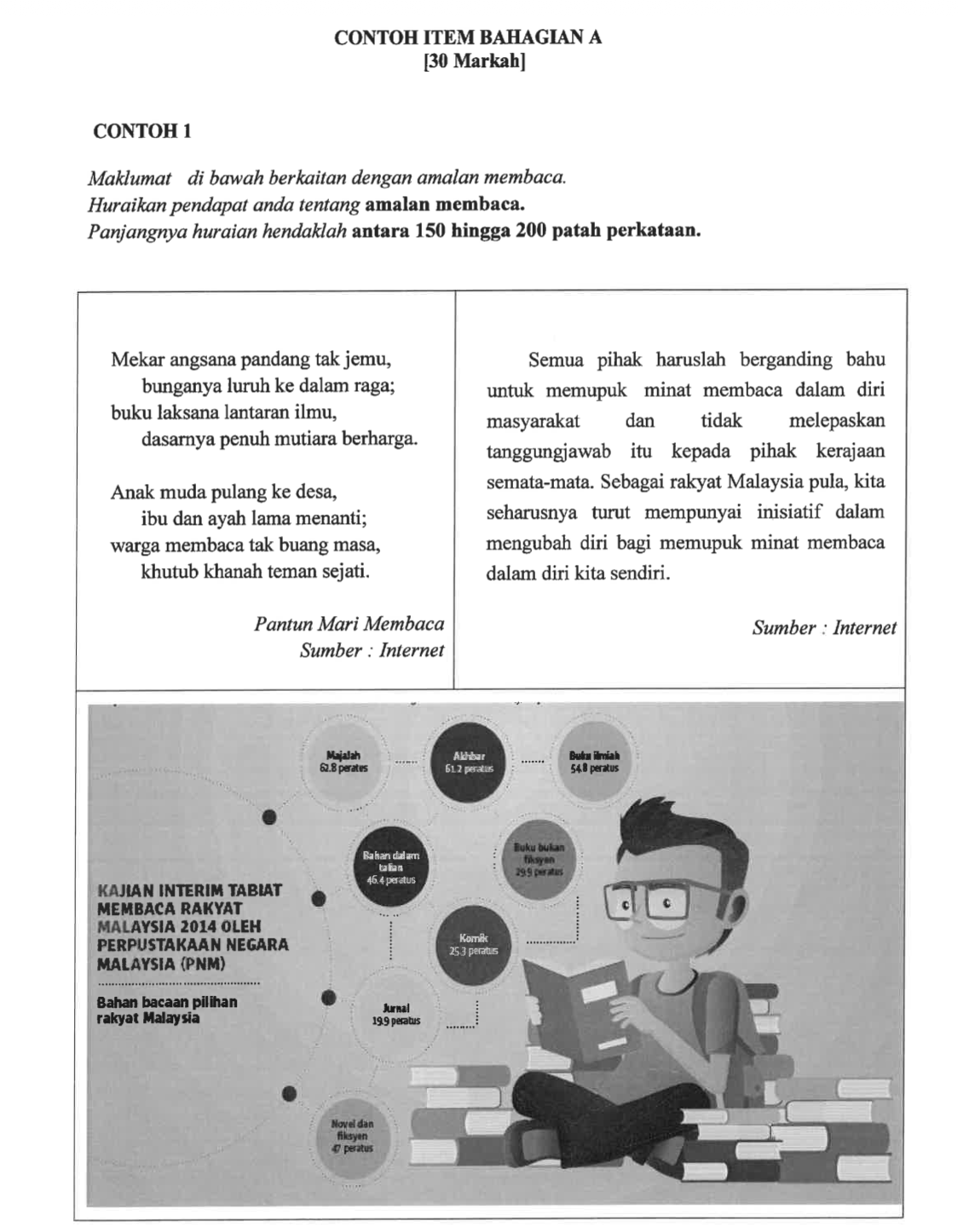
Here's an example of a Bahagian A stimulus: candidates are given a pantun about reading culture alongside an infographic on Malaysian studying habits, then asked to write 150–200 words sharing their opinion on amalan membaca (reading habits). The key is to address the stimulus directly. Don't write a general response that ignores the materials provided.¹
Learn how to master karangan crafting with examples and tips in our guide on SPM Malay essay drafting techniques.
2. Reading and Comprehension (Kertas 2)
Although Kertas 2 is also a written examination, it focuses on the ability to comprehend, apply, analyse, evaluate, and create meaning via perusal skills. You will study texts like passages, poems, prose, short stories, proverbs (peribahasa), and excerpts from literature, then respond to both limited-response and open-response subjective items.
Skills needed:
- Read for main ideas. Understand what the passage is generally about.
- Pick up the clues in the text. Reading between the lines and interpreting implied meanings.
- Read the questions clearly. Answer what they are asking for directly and concisely. For example, when the question is asking to list (senaraikan), avoid long sentences.
Tip: Practise with newspaper articles and literature extracts from your textbook to build reading stamina and vocabulary.

3. Speaking (Kertas 3)
Kertas 3 evaluates students' speaking skills as well as their level of understanding, application, analysis, and creativity. This examination has two sections: Section A: Individual and Section B: Group. For both sections, you are required to deliver your ideas in front of an examiner according to the topics provided to you.
Skills needed:
- Confidence in speaking in Malay. Practice speaking in Malay aloud often on various topics like school, hobbies, or social issues.
- Organise your thoughts. Learn how to introduce your arguments, explain them with examples, and end with a conclusion.
- Group discussion etiquette. Respond respectfully, agree and disagree politely, and take turns without dominating the discussion.
Tip: Practise with friends or record yourself responding to a rubric for 3–5 minutes. Then listen and reflect.
4. Listening (Kertas 4)
The final paper, Kertas 4, is a listening test where you will listen to a short audio clip (a conversation, dialogue, or passage) and respond to items based on it. The audio clip will be played twice.
Skills needed:
- Pick out the main ideas. You need to listen carefully to get the key points of the questions.
- Focus while listening. Train yourself to listen actively without getting distracted easily.
- Note-taking while the audio is playing. Learn to jot down brief pointers, keywords, numbers, names, short phrases, or anything that you find could be helpful later on while listening.
Tip: Practise listening to BM podcasts, BM news radio, or YouTube channels. Pause and replay segments to test understanding.
Bahasa jiwa bangsa—language is the soul of a nation.
Malaysian proverb
📚 Common Topics and Themes in SPM Melayu
Practising the popular test topics and themes is an important part of your preparation strategy. Here are frequent themes and examples (but not limited to) that you should cover when practising:
- Environment (Alam Sekitar). Topics include pollution, sustainability, and efforts to protect nature.
- Family (Keluarga). Covers relationships within the family, the roles of parents, and the values in building a harmonious home.
- Education (Pendidikan). Discusses schooling, learning methods, lifelong education, and the importance of education in national development.
- Health and lifestyle (Kesihatan and Gaya Hidup). Physical and mental health, balanced diets, exercise, healthy habits, and common illnesses among Malaysians.
- Technology and social media (Teknologi and Media Sosial). Pros and cons of technology and social media, and how they influence communication, lifestyle, and society.
- Culture (Budaya). Explores cultural heritage, traditions, customs, arts, and how these shape identity and unity in a multiracial society.
- Current issues (Isu Semasa). Social, economic, and political issues affecting Malaysia and the world.
- Patriotism and nation (Patriotisme and Negara). National unity, pride in national identity, and citizens' roles in contributing to the nation's progress and stability.
When practising karangan, don't just write about one issue repeatedly. Rotate through different themes each week so that you're prepared for any question that appears on test day. Many of these topics overlap. For example, a question about teknologi might also touch on pendidikan or kesihatan.
✍️ Marking Scheme for Bahasa Melayu SPM 2026
Understanding how examiners score your papers helps you know where to invest your time and effort. Here's a breakdown of the marking scheme for each paper:
- Kertas 1 (1103/1). With 30 points for Bahagian A and 70 points for Bahagian B, this component totals 100 marks. Scoring is holistic. Examiners assess your response as a whole based on content, language accuracy, and overall quality of the draft.
- Kertas 2 (1103/2). The 100 points for this paper are split across three sections. 35 for Bahagian A (grammar and language system), 35 for Bahagian B (comprehension and literature), and 30 for Bahagian C (rumusan). Scoring uses both analytical (marking specific elements) and holistic methods.
- Kertas 3 (1103/3). Worth a total of 70 marks, 40 for the individual section (Bahagian A) and 30 for the group discussion (Bahagian B). Examiners assess your fluency, vocabulary, pronunciation, ideas, and how well you interact during the group discussion. Scoring is analytical and holistic.
- Kertas 4 (1103/4). The listening component carries 30 marks. It includes a mix of multiple-format objective questions, and short subjective answers. Scoring is dichotomous (right/wrong) for MCQs and analytical for subjective responses.
Examiners use holistic scoring, meaning they read your entire karangan and assign a band based on the overall quality. Key factors include: relevance to the topic, depth and development of isi (main arguments), use of peribahasa and idiomatic expressions, correct grammar (tatabahasa), and essay structure (pengenalan → isi → penutup). A well-structured essay with 4–5 strong main pointers and good language will typically score in the upper bands.
For detailed scoring methods and examiner tips, check our full guide on the SPM Malay paper marking scheme.

📜 Where to Find Bahasa Melayu Past Year Papers
Working through past year tests is one of the most effective ways to prepare. It familiarises you with the format, helps you manage your time, and lets you practise answering under realistic conditions.
Check out these resources:
- Carousell Malaysia. An online marketplace where you can search for BM past papers under the Books and Stationery section. Use filters like condition, price, and deal options to find the papers that meet your preferred quality.
- Popular and MPH bookstores. These major bookstores sell model past-year papers for various subjects in both paperback and online formats. If you're a member, you might get discounted prices on selected items.
- Facebook groups. An unconventional yet useful option. Some teachers share BM tests here for free. You may not find the complete collection, but it's still a good supplementary source.
- Lembaga Peperiksaan website. The official LP site provides the test format document with sample questions for all four papers, which is a helpful starting point.
Want the full collection of BM past year papers? Check out these websites for a wider selection!

📆 A+ Flexible Study Plan for SPM Bahasa Melayu
Preparing for the exam can be overwhelming, especially when you're juggling school, tuition classes, extracurricular activities, and multiple subjects. That's why you need a plan that's not only effective, but also realistic, flexible, and tailored to your day-to-day life.
This is not a one-size-fits-all schedule. It's a guide you can adapt based on your own pace, energy levels, and needs. You are in control here.
Shall we look at the template?
| Day | Focus Area | Time Needed |
|---|---|---|
| Monday | Karangan (Bahagian A): Practice brainstorming & intro writing | 1 hr |
| Tuesday | Tatabahasa + Vocabulary Builder | 30 mins |
| Wednesday | Kefahaman (Comprehension) – Do 1 past year text | 1 hr |
| Thursday | Karangan (Bahagian B) – Full essay (Choose A or B) | 1 hr |
| Friday | Rumusan | 30 mins |
| Saturday | Speaking + Listening Practice + Watch BM videos | 1 hr |
| Sunday | Review: Model essays, peribahasa, intro and conclusion samples | 1 hr |
Tips to Make It Fun and Doable
- Gamify your learning. Use apps like Quizlet or Kahoot for vocabulary and idioms. Alternatively, challenge a friend to a "BM idiom challenge" on WhatsApp with a prize to win.
- Mix learning styles. Combine perusing, drafting, listening, and watching to add variety. Follow BM-speaking creators, listen to BM podcasts, or watch Malay news with subtitles.
- Use the Pomodoro technique. Work for 25 minutes, then take a 5-minute break. It's great for maintaining focus without burning out.
- Keep a "progress tracker." A simple checklist helps you stay on track: "Done one Karangan this week", "Reviewed 10 proverbs", etc. Seeing your wins keeps you motivated.
Tweak It Your Way!
- Some weeks can be busier than others. You can always swap days or reduce your sessions.
- Got extra time one weekend? Use that to prep for the following week and take a break midweek.
- Struggling with one area (e.g., Pemahaman)? Spend 2 sessions on it next week instead of Tatabahasa.
- Remember, it's your plan. Following others' plans may not necessarily translate into your personal progress. Everyone is different, so make it work for you!
- This sample template works for students across many levels, such as those in international schools in Malaysia, or even those at the pre-university, foundation, and university levels.
Source: Malay Mail
📝 Exam Day Tips for SPM Bahasa Melayu
After months of hard work and preparation, the last thing you want is for exam day nerves to get in the way. With the right strategies, you can turn that anxiety into focus and confidence.
Before the Exam
- Arrive early and prepared. Aim to be at the exam hall at least 30–45 minutes early. Bring extra stationery (in case one pen runs out of ink), your IC, and exam slip. During this time, you should focus on your own revision notes to prepare mentally for the paper.
- Don't skip breakfast. Eat something light and energising (e.g. oats, banana, bread). Avoid heavy or sugary food that makes you feel sleepy or jittery.
During the Papers
- Divide your time wisely. For Kertas 1, allocate roughly 45 minutes for Bahagian A and 1 hour 15 minutes for Bahagian B. For Kertas 2, don't spend too long on any one section. Leave at least 10–15 minutes at the end to check your answers.
- Read the instructions carefully. Underline key words in every question. Understand the need, focus, and requirements before you start answering.
- Make a quick outline for Kertas 1. Whether it's a mind map or bullet points, plan your karangan before crafting. Keep your essay on topic and make sure each main point connects clearly.
- Use the IMBAKUP method in Kertas 1 Bahagian B. This helps you organise your main points clearly so the whole essay flows better.
✅ Do
- Underline keywords in every question
- Plan your karangan before drafting
- Leave time to check spelling and grammar
- Take a quiet breath before the oral test
- Trust your preparation
❌ Don't
- Rush into writing without a plan
- Spend too long on one section
- Discuss answers with friends between papers
- Panic if you're stuck—move on and return later
- Dwell on a paper once it's done
After Each Test
- Don't overthink it. You may be tempted to know how your friends answered. However, it may be more helpful to redirect your energy to the next examination.
- Take a rest. Focus your energy on what's coming next. You've earned a break.
🎓 Beyond SPM Bahasa Melayu Tips: Preparing for STPM, University, and Foundation Programmes
Scoring well in SPM Bahasa Melayu opens the door to multiple pathways beyond secondary school. For STPM, a strong BM foundation is essential since Malay is offered as a full subject across three semesters. Foundation programmes at local universities also typically require a pass in BM, and many degree programmes, even in science, business, or engineering, expect you to have met this requirement at the SPM level.
For those considering international pathways, having a solid BM result on your result slip still matters. Some universities and scholarship bodies look at your overall SPM performance, including the national language, as part of their assessment.
In short, whether your next step is STPM, a diploma, a foundation course, or applying abroad, investing in your Melayu performance is a step toward future success.
Sometimes, targeted assistance from a tutor can make the difference between a pass and an A. A good tutor can identify your weak areas, give personalised feedback on your karangan writing, and help you build confidence for the speaking examination.
Superprof offers tutoring lessons for various levels, from IGCSE to SPM. With over 1,700 Malay tutors available, you can opt for face-to-face or webcam lessons. Every tutor's teaching experience and education level are verified before their profile goes live.
You can discover a Malay language course on Superprof. Many tutors offer a free first lesson, so you can find the right fit. 🎓
References
- "Format Pentaksiran Mulai Tahun 2021: Bahasa Melayu (Kod: 1103)," Lembaga Peperiksaan, Kementerian Pendidikan Malaysia, 2020. Available at: https://lp.moe.gov.my/images/bahan/spm/2021/BukuFormatSPM2021/BAHASA%20MELAYU%20(1103).pdf. Accessed 27 April 2026.
Summarise with AI:
Did you like this article? Leave a rating!

 Loading...





Hi,
I am a foreigner and married to a Malaysian. I am going to start working in the health care sector. I would like to study for and take SPM Malay so that I may be more assimilated into Malaysian life and built rapport with my patients.
May I check if foreigners can take Malay SPM?
Tq so muchh for guide me im going to q forward a step for form 4 i will do my level besst
All the best!