
A bowl of rambutan on the dining table is breakfast. Light it from one side, arrange it with a folded batik cloth, and paint it with care. Then it becomes still life art. Artists have been turning fruit, flowers, and kitchen pots into art for more than 2,000 years, and the genre is still everywhere. You’ll find it in museum collections, Pendidikan Seni Visual lessons, product photography, and the styled flat lays on your Instagram feed.
This guide explains what still life art is, how to recognise it, where it came from, which still life art pieces are worth knowing, and how to make your own.
| Still Life Art | At a Glance |
|---|---|
| What it is | Artwork whose main subject is a group of carefully arranged inanimate objects |
| Typical subjects | Fruit, flowers, books, bottles, food, ceramics, and household items |
| Forms | Painting, drawing, photography, printmaking, digital art, and mixed media |
| What artists explore | Colour, light, texture, shape, and symbolism |
| Key periods | Ancient Egypt and Rome, the Dutch Golden Age, Post-Impressionism, Cubism, and Pop Art |
| Famous examples | Caravaggio's Basket of Fruit, Van Gogh's Sunflowers, and Cézanne's apple still lifes |
Insects, birds, or even people sometimes appear in still life paintings, but the focus of traditional still life art stays on the objects.


What Is Still Life in Art?
The definition of still life in art is simple: a work whose main subject is a group of inanimate objects that the artist has arranged on purpose. The English term comes from the Dutch stilleven, which came into use in the mid-17th century. French speakers call the genre nature morte, or “dead nature”.
When people ask what still life in art means, they usually picture an oil painting of fruit on a table. Painting is the best-known form, but still life also covers drawing, photography, printmaking, sculpture, digital illustration, and mixed media.
The objects themselves are often ordinary. What makes a still life artwork worth looking at is how the artist treats them: the light, the arrangement, and the attention paid to a dented pot or a bruised pear.
Artists choose still life subjects for practical and creative reasons:
- They can control the light and keep it the same for days.
- The objects are cheap and already at home.
- Fruit and bottles don't move, so there is time to observe closely.
- Objects can carry symbols and tell a story without any people in the picture.
- A table-top arrangement is an easy place to test new ideas about composition, colour, and materials.
Common Subjects in Still Life Artwork
Common subjects in still life art include:
- Food and drink, such as fruit, bread, tea, coffee cups, bottles, spices, and pastries
- Nature, such as flowers, leaves, shells, stones, and dried plants
- Householdobjects, such as books, candles, clocks, kitchenware, jars, and fabric
- Cultural and personal items, such as musical instruments, heirlooms, textiles, letters, and handicrafts
Still Life Art vs Other Art Genres
If you are unsure whether an artwork counts as still life, check its main subject.
| Genre | Main Subject | Example |
|---|---|---|
| Still life | Inanimate objects | Fruit and ceramics on a table |
| Portraiture | A person or people | A self-portrait |
| Landscape | Natural or urban scenery | A kampung or city skyline |
| Figure drawing | The human body | A posed model |
| Wildlife art | Animals | Birds or marine life |
Key Features of Still Life Art
A strong still life is more than a picture of objects. Six elements are crucial, and once you know them, you can read almost any still life art piece.
| Feature | What to Look For |
|---|---|
| Composition | How the objects are placed to lead your eye |
| Light and shadow | Highlights, reflected light, and cast shadows that create form |
| Colour | Harmonious, contrasting, or symbolic choices |
| Texture | Shiny glass, rough fruit skin, soft cloth, cold metal |
| Perspective | Objects that sit believably in space |
| Symbolism | Objects that stand for wealth, faith, time, or memory |
Are non-living objects the main subject? Do they look deliberately arranged? Are people and animals absent or minor? If you answered yes three times, you are looking at a still life.
Symbolism in Still Life Art
Many 17th-century Dutch still lifes carry hidden messages. The best-known type is vanitas, from the Latin word for “emptiness”. These paintings remind viewers that life is short and earthly possessions don't last. For example:
- Skulls, pocket watches, and snuffed-out candles point to death and the passing of time.
- Ripe fruit and fresh flowers suggest abundance and beauty, but a wilting petal or a fly hints that both will fade.
- Books, maps, globes, and musical instruments can signal learning, travel, or status.
Not every still life hides a message, though. Many modern artists paint a jug or a lemon simply for its colour and shape.
Still Life Subjects in a Malaysian Context
You don't need Dutch silverware to make a still life. Everyday Malaysian objects work just as well. Think:
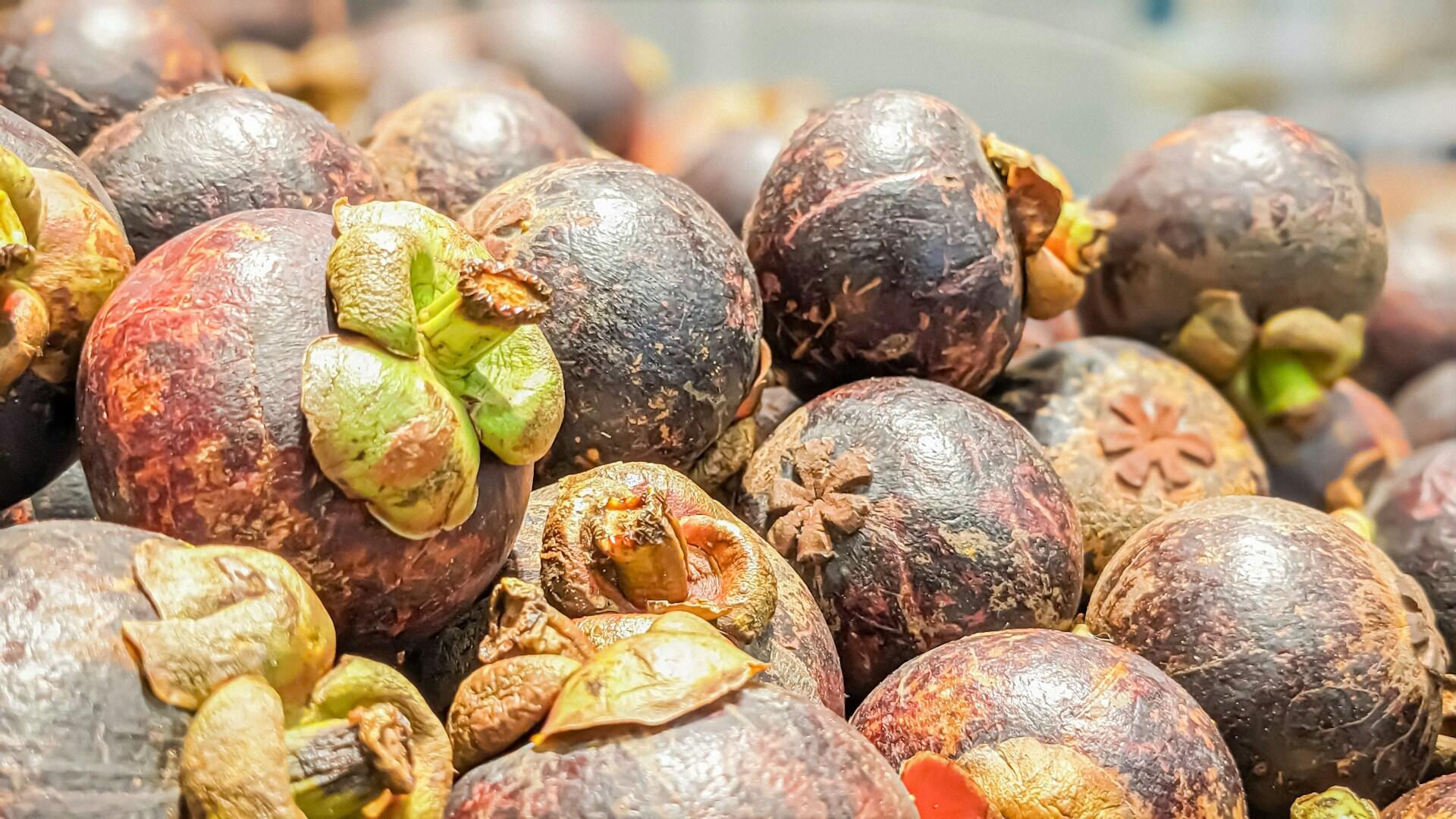
- Mangosteen, rambutan, pineapple, and bananas on a woven tray
- A glass of teh tarik, a kopi cup, and kaya toast
- Batik cloth, songket-inspired patterns, or a mengkuang mat
- A rattan basket with ceramic bowls, lemongrass, and star anise
- Mandarin oranges at Chinese New Year, oil lamps at Deepavali, or a tray of festive kuih at Hari Raya
Treat objects linked to religion or heritage with respect, and name them accurately when you title or describe your work.
The History and Evolution of Still Life Art
Still life started as decoration in tombs and villas, became a genre of its own in 17th-century Europe, and now turns up in photography, advertising, and social media.
Here is the short version; our full history of still life goes deeper, and the Met's Heilbrunn Timeline of Art History1 is a reliable place to check dates and works.
From Ancient Times to the Middle Ages
Ancient Egyptians painted baskets of figs, grapes, bread, and meat on tomb walls, believing the objects shown would accompany the dead into the afterlife.
The Greeks valued realistic painting so highly that the Roman writer Pliny the Elder told of Zeuxis, a Greek painter whose grapes looked so real that birds flew down to peck at them.
Roman homes in Pompeii and Herculaneum, buried and preserved by the eruption of Vesuvius in 79 AD, had wall paintings and mosaics of fish, fruit, and glass bowls. These are sometimes called xenia because they echoed the food hosts gave their guests. One of the best-known, Still Life with Peaches, shows ripe peaches beside a glass jar of water and came from a house in Herculaneum.
In medieval Europe, objects mostly appeared as supporting details in religious art. A white lily in a scene of the Annunciation, for example, stood for the Virgin Mary's purity. Some manuscript painters went further. The Hours of Catherine of Cleves, a Dutch prayer book made around 1440, fills its page borders with startlingly lifelike mussels, coins, fish, and pretzels, painted to trick the eye.
The Renaissance
Renaissance artists worked out linear perspective, studied proportion, and used oil paint to render surfaces in fine detail.
Objects began to step out from the background. Jacopo de' Barbari's Still Life with Partridge and Iron Gloves (1504) is often cited as one of the earliest independent still lifes.
From the mid-16th century, painters in the Low Countries were filling market and kitchen scenes with piles of food, setting the stage for what came next.
The Dutch Golden Age
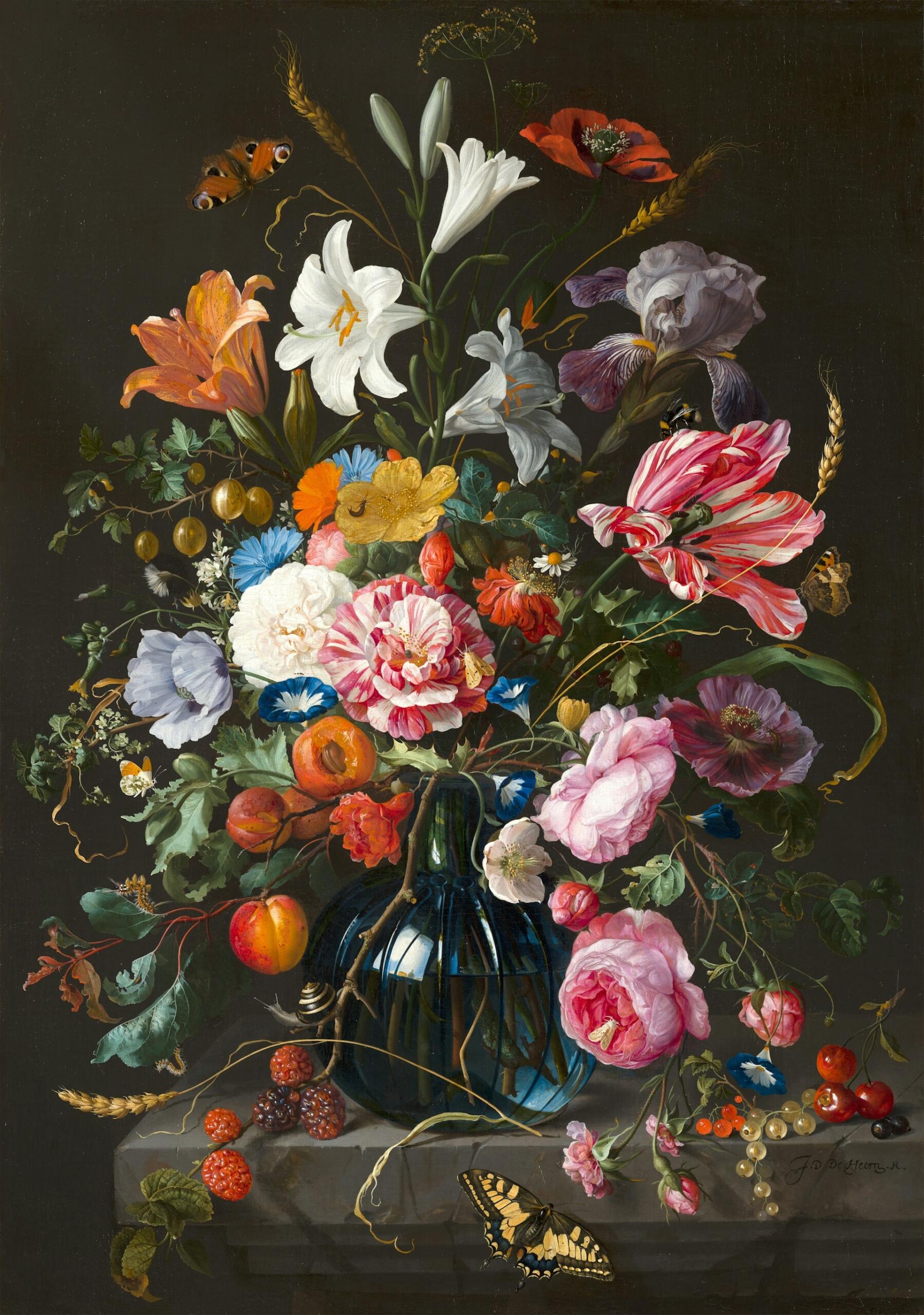
The 17th-century Dutch Republic turned still life into a full genre. Wealthy merchants wanted paintings for their homes rather than churches, and global trade filled their tables with porcelain, lemons, spices, and tulips worth showing off.
There is a local connection here. The Dutch took Melaka from the Portuguese in 1641, and pepper and nutmeg from the Malay Archipelago were part of the trade that made Dutch merchants rich.
Dutch painters developed several subgenres:
- Flower pieces, often combining blooms that flowered in different seasons
- Breakfast pieces (ontbijtjes), with bread, cheese, and a glass of beer
- Banquet pieces (banketjes), with richer food and silverware
- Vanitas paintings, with skulls, watches, and candles
- Pronkstilleven, or showy displays of silver, Chinese porcelain, and lobster
Impressionism, Post-Impressionism, and Modern Art
For a long time, still life sat at the bottom of the ladder. In the 17th century, the French Royal Academy ranked painting genres by importance, with history and religious scenes at the top and still life last.
That ranking lost its grip in the 19th century. As photography spread, it took over much of the job of recording objects exactly, and many painters grew less interested in perfect realism.
Édouard Manet and the Impressionists used loose, visible brushstrokes, often worked wet paint into wet paint, and watched how light and colour bounced from one object to the next.
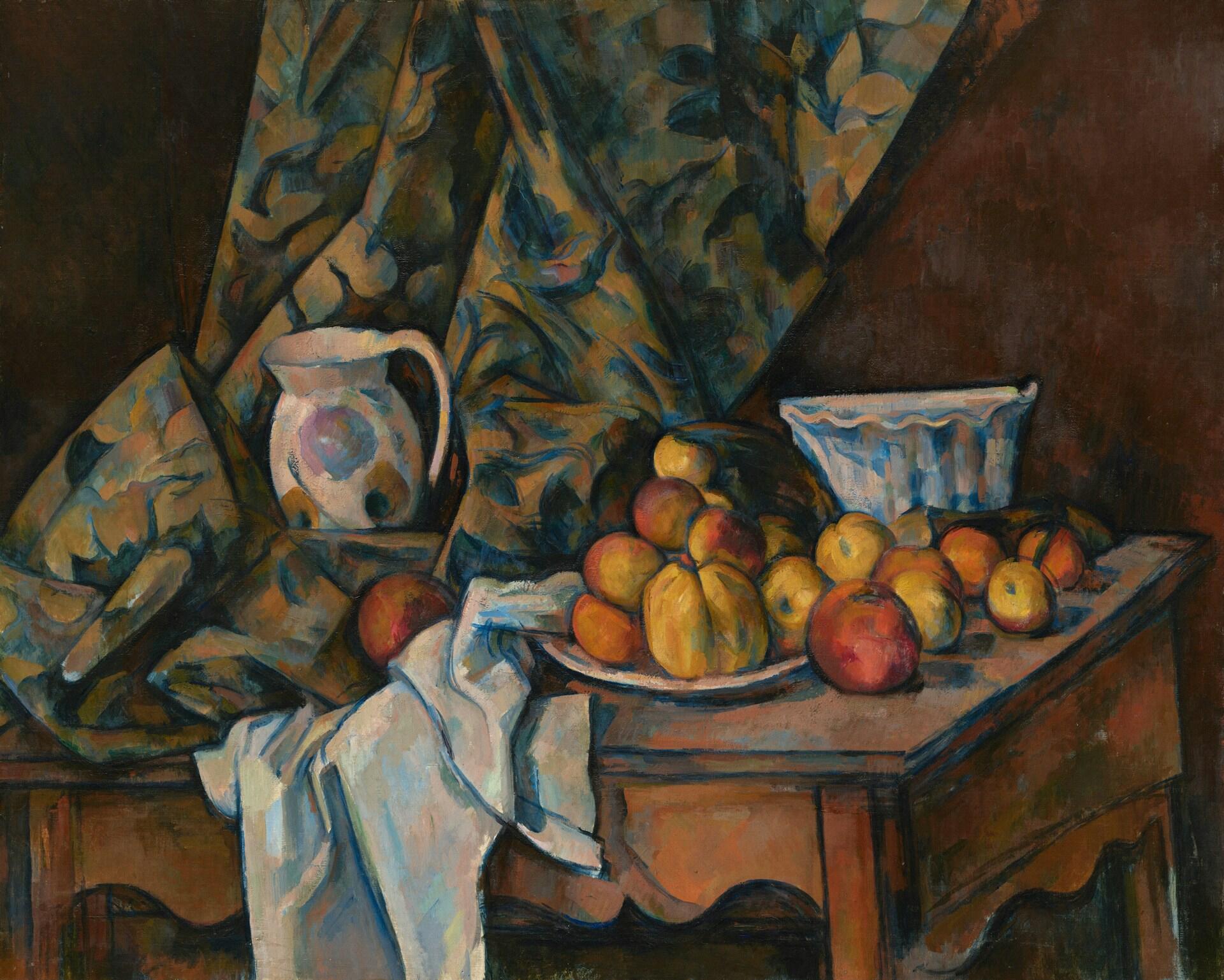
Paul Cézanne went further, tilting tabletops and showing fruit from more than one viewpoint at once. His Post-Impressionist approach fed directly into Fauvism and Cubism.
Around 1908, Pablo Picasso and Georges Braque began breaking bottles, guitars, and newspapers into flat, overlapping planes in Cubism. Picasso's Still Life with Chair Caning (1912) glued a printed oilcloth onto the canvas, an early example of collage.
Fifty years later, Andy Warhol's Campbell's Soup Cans (1962) turned supermarket packaging into Pop Art. Read more in our guide to modern still life.
Traditional Still Life (1600s and 1700s)
- Highly realistic, carefully finished detail
- Arranged food, flowers, and luxury objects
- Hidden symbolism, especially vanitas
- Smooth surfaces with brushwork kept quiet
Modern Still Life (Late 1800s Onwards)
- Simplified, geometric, or abstract forms
- Tilted tables and more than one viewpoint
- Everyday or mass-produced objects
- Visible brushwork, collage, and new materials
Contemporary Still Life Art
Today, still life lives in photography, digital art, installation, advertising, and social media. Food photographers and brand stylists use the same rules of light and arrangement as 17th-century painters.
Contemporary artists also use the genre to question consumerism, waste, food systems, and cultural identity, sometimes building work from found objects or recycled materials.
Sam Taylor-Johnson's film Still Life (2001), for example, shows a bowl of fruit rotting in time-lapse, an update of the vanitas idea for the video age.
Famous Still Life Art Pieces and Artists to Know
These seven artists span more than 350 years of famous still life art, from Baroque realism to the pared-back painting of the 20th century. For more names, see our list of famous still life artists.
- Caravaggio (Italian, 1571 to 1610), Basket of Fruit, c. 1599. Look closely, and you'll see wormholes in the apple and leaves drying at the edges. Caravaggio painted fruit as it really was, and the small signs of decay hint that beauty doesn't last.
- Pieter Claesz (Dutch, c. 1597 to 1660), Vanitas Still Life, 1630. A skull, a pocket watch, a toppled glass, and a burnt-out lamp sit in muted browns and greys. It is a textbook vanitas painting.
- Rachel Ruysch (Dutch, 1664 to 1750), flower pieces. Ruysch's bouquets are botanically precise and full of movement, with insects and dew drops tucked between the petals. She became court painter in Düsseldorf and is one of the most important women artists of the Dutch Golden Age.
- Jean Siméon Chardin (French, 1699 to 1779), The Ray, 1728. Chardin found beauty in copper pots, kitchen jugs, and humble food. The Ray won him a place in the French Royal Academy, even though the Academy ranked still life as its lowest genre.
- Paul Cézanne (French, 1839 to 1906), Still Life with Apples, 1895 to 1898. Notice the tilted table and the fruit seen from slightly different angles. Cézanne is often quoted as saying he wanted to astonish Paris with an apple.
- Vincent van Gogh (Dutch, 1853 to 1890), Sunflowers, 1888. Van Gogh painted his sunflower series in Arles using thick, energetic paint and bold yellows. One version belongs to the National Gallery, London2.
- Giorgio Morandi (Italian, 1890 to 1964), bottles and vessels. Morandi painted the same dusty bottles and jars for decades in muted tones. His work shows how much an artist can say with very little.
It is not the language of painters but the language of nature which one should listen to.
Vincent van Gogh, from his letters
You can zoom in on many of these works on Google Arts & Culture. Closer to home, the National Art Gallery Malaysia in Kuala Lumpur holds the national collection and runs regular exhibitions, so it's worth checking what's on.
How to Look at a Still Life Artwork
Next time you stand in front of a still life, in a gallery or on your phone, work through these questions:
- What objects can you see?
- Where is the light coming from?
- Which object is the focal point?
- Which textures has the artist made a point of showing?
- Could any object have symbolic or cultural meaning?
- How does the artwork make you feel?
How to Create a Still Life Drawing or Painting
The best way to understand still life art is to make some. Here are the basics; our still life drawing guide walks through shading and technique in more detail.
Choose Simple Objects and a Clear Theme
Start with three to five objects. You can go with one large, one medium, one small, plus a cloth or sheet of paper behind them. A theme helps the group feel connected. Try one of these:
- A mug, a local fruit, and a folded batik cloth
- A bowl, a spoon, a lime, and a small bottle
- A book, a pair of spectacles, and a cup of kopi
Arrange the Composition
Use one light source, such as a window or a desk lamp, so the shadows are clear. Don't line the objects up in a row. Let some overlap to show depth, and place the most interesting one about a third of the way across, using the rule of thirds as a guide rather than a law. Take a quick photo of the set-up so you can rebuild it if someone moves the fruit.
Draw or Paint Step by Step
- Sketch the basic shapes lightly.
- Check proportions and angles against the real objects.
- Establish the darkest shadows.
- Add mid-tones and highlights.
- Build up texture gradually.
- Refine edges and clean up stray marks.
Common Mistakes to Avoid
Stay away from:
- Pressing too hard on outlines early on
- Leaving out shadows, so objects look like they're floating
- Lighting the set-up from several directions
- Giving every object the same level of detail
- Forgetting the table surface and background
- Copying a photo without studying the real light and form
Materials for Beginners
An HB and a 2B pencil, an eraser, a sharpener, and a sketchbook are enough to start. For colour, add coloured pencils, watercolours, gouache, or acrylics, and work near a window or under a desk lamp. Local art shops, bookshops, and online marketplaces stock all of these at student prices.
If you'd like guidance on composition or help preparing a Seni Visual portfolio, you can find an art tutor on Superprof for lessons at home or online.
References
- Liedtke, W. (2003, October). Still-life painting in Northern Europe, 1600-1800. In Heilbrunn Timeline of Art History. The Metropolitan Museum of Art. Retrieved October 4, 2026, from https://www.metmuseum.org/essays/still-life-painting-in-northern-europe-1600-1800
- The National Gallery. (n.d.). Vincent van Gogh, Sunflowers, 1888. Retrieved October 4, 2026, from https://www.nationalgallery.org.uk/paintings/vincent-van-gogh-sunflowers
Summarise with AI:
Did you like this article? Leave a rating!

 Loading...